


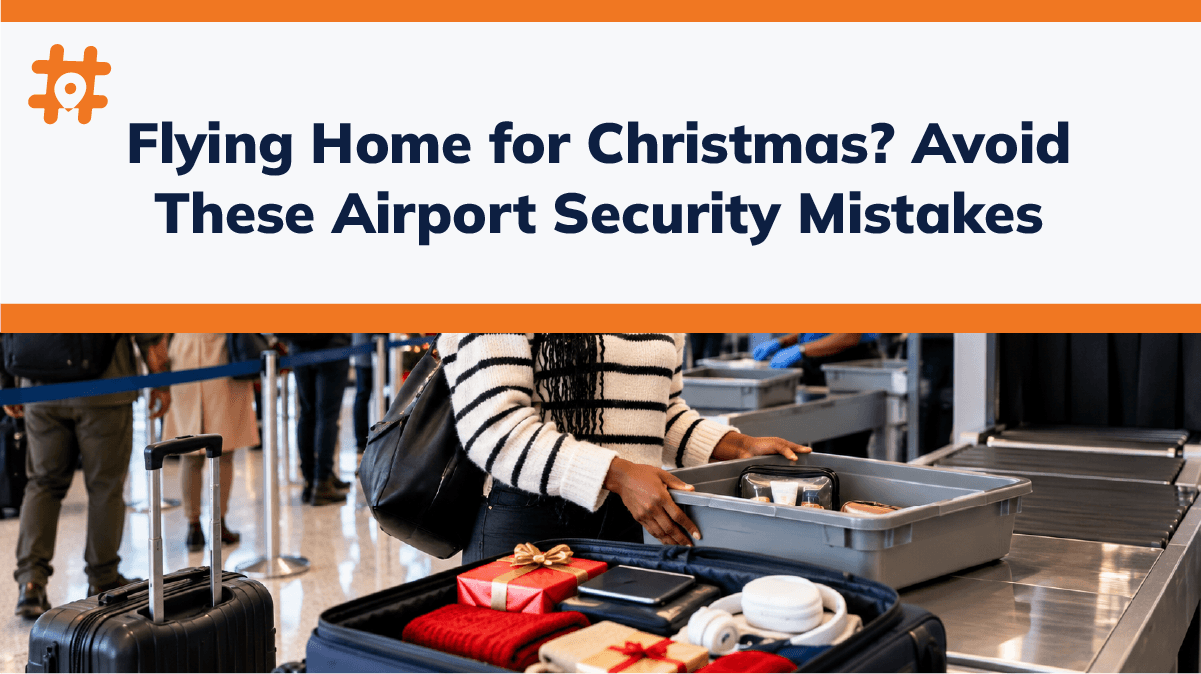
Christmas travel is exciting until you reach the airport with two suitcases, a carry-on full of gifts, a phone at 18% battery and a security queue that seems to have no end.
The holiday season is one of the busiest periods of the year for air travel. Airports become crowded, baggage becomes heavier, and travellers are more likely to carry things they would not normally take on a flight, gifts, perfumes, food, electronics, children’s toys, Christmas decorations and other items for family and friends.
That is where small packing mistakes can become big travel problems.
A gift wrapped perfectly at home may need to be opened for security screening. A large bottle of perfume may not be allowed through security in your hand luggage. A power bank that seemed harmless may need to stay in your cabin bag rather than your checked suitcase. Even food that looks completely ordinary can fall under liquid or gel restrictions.
This Christmas airport security guide explains what to know before you leave home, how to pack gifts for air travel, what commonly causes delays at security, and how to make your holiday journey less stressful.
Important: Airport security rules are not identical everywhere. Your departure airport, connecting airports, airline and destination can all have different requirements. Always check the current rules for every airport on your itinerary before travelling.
Christmas Airport Security Checklist at a Glance
Before leaving for the airport, make sure you have:
- Checked your airline’s baggage allowance
- Checked the security rules at your departure airport
- Checked connecting-airport requirements if you have a layover
- Kept important documents and valuables in your hand luggage
- Packed power banks and spare lithium batteries correctly
- Checked the rules for liquids, gels, creams and aerosols
- Avoided putting prohibited or questionable items in your luggage
- Kept gifts accessible for possible inspection
- Removed unnecessary clutter from your carry-on
- Allowed extra time for check-in and security
- Avoided carrying luggage for someone you do not know
For travellers departing from Nigerian airports, FAAN specifically advises passengers to pack their own luggage, never assist another person with their luggage, and avoid leaving luggage unattended.
Why Christmas Airport Security Can Feel Different
Airport security itself does not suddenly become optional or fundamentally different because it is Christmas.
What changes is the volume and type of luggage passing through the airport.
Holiday travellers often carry:
- More checked baggage
- More hand luggage
- Gifts
- Food
- Liquids and cosmetics
- Children’s items
- Electronic devices
- Power banks
- Christmas decorations
- Duty-free purchases
All of this can make security screening more complicated.
A bag that is tightly packed with unrelated items can also be harder to screen. The TSA, for example, advises passengers to keep carry-on bags organised because food, powders and clutter can obstruct clear X-ray images and may result in additional screening.
The lesson is simple:
Pack for security, not just for your destination.
1. Can You Take Christmas Gifts Through Airport Security?
Yes, in many cases.
Most ordinary gifts, such as clothes, books, toys, shoes and many household items — can travel by air.
The bigger question is what the gift contains and where you pack it.
For example:
- A sweater is generally straightforward.
- A boxed phone may require attention to battery rules.
- A bottle of perfume may be subject to liquid restrictions.
- A bottle of wine may need to go into checked baggage unless purchased under applicable duty-free procedures.
- A toy that resembles a weapon may receive additional scrutiny.
- A gift containing a sharp object may not be permitted in your cabin baggage.
So don’t judge a gift simply by its appearance.
Ask:
Could any part of this gift be considered a liquid, sharp object, battery, dangerous good or restricted item?
2. Should You Wrap Christmas Gifts Before Flying?
You can wrap gifts, but wrapping them before security can be inconvenient.
Security officers may need to inspect an item if it triggers an alarm or requires additional screening.
That means a beautifully wrapped present could be opened and inspected.
A better approach
If you’re travelling with gifts, consider:
- Using gift bags instead of tightly wrapping everything
- Carrying wrapping paper separately
- Wrapping gifts after arriving
- Keeping easily inspectable gifts accessible
This is particularly useful when you have several gifts in your cabin baggage.
The goal isn’t to make security suspicious of your presents. It’s simply to avoid turning a security inspection into a Christmas gift-unwrapping session.
3. Can You Take Perfume Through Airport Security?
Perfume is treated as a liquid for airport-security purposes.
The rules depend on the airport.
At UK airports, for example, most airports do not allow containers larger than 100ml through security in hand luggage, although some airports may permit containers up to 2 litres following changes in screening technology. The UK government specifically advises passengers to check the rules of their departure and connecting airports because requirements can differ.
This means a 150ml perfume bottle that is only half full can still be a problem where the 100ml container limit applies.
It is the container’s capacity that matters, not simply how much liquid is inside.
FAAN’s passenger guidance similarly identifies perfumes, cosmetics, drinks and other liquids, gels, creams, pastes and aerosols as restricted items and says the container size is what is assessed at security.
Christmas tip
If perfume is one of your gifts:
Check the security rules before putting it in your hand luggage.
If the item is permitted in checked baggage, packing it there may be simpler.
4. What About Christmas Food?
Food is one of the easiest areas to get wrong because solid food and liquid or gel-like food can be treated differently.
Examples that may require additional consideration include:
- Honey
- Jam
- Sauces
- Soup
- Yogurt
- Cream-based products
- Spreads
- Drinks
- Oils
FAAN specifically includes foods containing high volumes of liquid, as well as spreads, jams and preserves, in its description of restricted liquids.
UK airport guidance similarly classifies items such as soup, jam, honey and syrups as liquids or semi-liquid foods for hand-luggage purposes.
What about solid Christmas food?
Solid food is generally easier to transport through security, but airport security is not the only consideration.
Your destination country may have customs, food-importation or biosecurity restrictions.
So there are two separate questions:
Can I take it through airport security?
and
Can I legally bring it into my destination country?
Don’t confuse the two.
5. Don’t Forget About Power Banks and Christmas Electronics
Electronics are increasingly common Christmas gifts.
If you’re travelling with:
- Smartphones
- Tablets
- Laptops
- Cameras
- Smartwatches
- Wireless headphones
- Gaming devices
- Power banks
- Spare batteries
check the battery requirements before travelling.
Spare lithium batteries and power banks are generally subject to stricter rules than ordinary personal electronics.
For example, TSA guidance says spare lithium-ion batteries and power banks must be carried in carry-on baggage rather than checked baggage, subject to applicable limits and airline requirements.
Why?
Lithium batteries can present a fire risk if damaged or if they overheat.
That is why airlines and aviation authorities have specific requirements for their transportation.
Christmas packing rule
If you’re giving someone a power bank for Christmas:
Don’t automatically put it inside your checked suitcase.
Check the airline’s current battery rules and keep the device appropriately protected.
Also check the battery’s Wh (watt-hour) rating where required.
6. Can You Take Christmas Crackers on a Plane?
This is a classic example of why holiday-specific items deserve extra attention.
Some Christmas crackers contain small explosive components or novelty items that may be subject to dangerous-goods restrictions.
Don’t assume that because something is sold as a Christmas decoration it is automatically acceptable on an aircraft.
Check with your airline and departure airport before packing Christmas crackers, novelty fireworks, sparklers or similar items.
The broader principle is important:
Festive does not automatically mean flight-safe.
Nigeria’s Civil Aviation Authority maintains specific dangerous-goods requirements for passenger travel and states that certain dangerous goods are forbidden while others are subject to quantity or carriage restrictions.
7. What Items Should You Never Put in Your Luggage Without Checking?
If you’re unsure about an item, check before travelling.
Particular categories that deserve attention include:
Dangerous goods
These can include certain:
- Flammable substances
- Corrosive substances
- Explosives
- Gas cylinders
- Fuels
- Fireworks
- Certain chemicals
The NCAA’s passenger dangerous-goods guidance confirms that some dangerous goods are prohibited while others may only be permitted subject to quantity and carriage restrictions.
Sharp objects
Knives, certain blades and other sharp objects may be restricted in cabin baggage.
Batteries
Power banks and spare lithium batteries have specific carriage requirements.
Aerosols
Items such as some sprays and deodorants may be subject to quantity and packaging restrictions.
Weapons or weapon-like items
Do not assume that a decorative or novelty item will automatically be allowed in your cabin baggage.
When in doubt, check with the airline or airport before packing it.
8. What Should Go in Your Hand Luggage at Christmas?
Your cabin bag should contain the things you would struggle to replace if your checked suitcase were delayed.
Consider keeping these with you:
- Passport
- Travel documents
- Phone
- Wallet
- Essential medication
- Prescription information where relevant
- Chargers
- Approved power bank
- Important valuables
- Essential toiletries within applicable security limits
- A change of clothes for longer journeys
- Important work documents
- Items needed by children during the journey
FAAN advises passengers travelling with essential medication to carry sufficient medication and says proof such as a doctor’s letter or prescription may be requested; medication can also receive additional screening.
UK guidance similarly permits essential liquid medicines above ordinary liquid limits, although passengers may need supporting documentation and should declare them at security.
9. Keep Your Carry-On Bag Organised
One of the easiest ways to slow yourself down at security is to arrive with a carry-on bag that looks like a drawer after Christmas morning.
A better system is to group items.
Section 1: Documents
Keep your passport and boarding information easily accessible.
Section 2: Electronics
Keep larger electronics where your airport requires or recommends them to be separated for screening.
Section 3: Liquids
Keep permitted liquids together in the appropriate bag where required.
Section 4: Medication
Keep essential medication accessible and carry supporting documentation when appropriate.
Section 5: Personal items
Keep smaller items such as keys, coins and other loose objects organised.
The exact process varies by airport, so follow the instructions given at your security checkpoint.

10. Empty Your Water Bottle Before Security
Travellers often remember the expensive gifts but forget the inexpensive bottle of water in their backpack.
At airports where the standard liquid restrictions apply, you may not be able to take a filled bottle through security.
The UK government notes that at most airports, liquids in containers larger than 100ml are not permitted through security, while some airports now have different arrangements.
Easy solution
Carry a reusable bottle.
Empty it before security.
Refill it after you pass the checkpoint where facilities are available.
It is a small habit that can save time.
11. Duty-Free Christmas Shopping Has Its Own Rules
Bought perfume, alcohol or another liquid at the airport?
Don’t assume that buying something after security means you can ignore the rules for the rest of your journey.
UK guidance states that duty-free liquids can be carried through security when they are sealed in an appropriate security bag with the receipt visible, and passengers should not open the security bag before reaching their final destination.
This becomes especially important if you have a connecting flight.
The fact that you passed through security at Airport A does not necessarily mean the same item will automatically pass through security at Airport B.
12. Christmas Travel with Children
Travelling with children adds another layer of planning.
Your hand luggage may contain:
- Baby food
- Formula
- Milk
- Bottles
- Medication
- Snacks
- Toys
- Extra clothing
Airport rules often contain specific exemptions for baby food, milk and essential medication.
For example, UK government guidance provides exemptions for baby food and baby milk, while FAAN also states that parents can carry milk powder, ready-to-drink formula and baby food in hand luggage.
Practical tip
Don’t hide children’s liquids or food at the bottom of your bag.
Keep them accessible and tell security staff what you’re carrying when required.
13. Give Yourself More Time at the Airport
Christmas airport travel is not the time to test how quickly you can move through an airport.
FAAN’s published Yuletide travel guidance has advised international passengers to arrive three hours before departure and domestic passengers two hours before departure.
Your airline may recommend a different check-in time, so follow its instructions as well.
Arriving early gives you room for:
- Traffic delays
- Parking
- Check-in
- Baggage drop
- Security queues
- Immigration
- Additional screening
- Finding your gate
The goal is not to spend three hours staring at the departure board.
The goal is to remove the pressure of having only three hours.
14. Never Carry a Stranger’s Bag
This deserves its own section because it is one of the most important Christmas travel rules.
If someone at the airport asks:
“Please help me take this bag to my family.”
Be careful.
Even if the person appears friendly or claims the bag contains harmless items, you should not carry luggage that you did not pack yourself.
FAAN specifically tells passengers to pack their own luggage and not assist anyone with their luggage.
If someone genuinely needs help, direct them to airport personnel.
Your passport and your ticket may belong to you.
But once you’re carrying someone else’s luggage, you may also be asked questions about what is inside it.
15. Never Leave Your Luggage Unattended
Christmas airports can be crowded enough to make people think:
“I’ll just leave this bag here while I go and buy something.”
Don’t.
FAAN explicitly advises passengers not to leave luggage unattended.
If you need assistance, speak to airport staff.
Keep your belongings with you throughout your journey.
16. What Happens If Security Stops Your Bag?
Don’t panic.
Additional screening does not automatically mean you’ve done something wrong.
Security may want to inspect a particular item because:
- It is difficult to identify on the scanner
- The bag is densely packed
- An item has triggered an alarm
- A liquid needs additional inspection
- An electronic device requires further examination
- The contents are unclear
The best response is cooperation.
Open the bag when instructed.
Explain what you’re carrying.
Remove the requested item.
If the item is not permitted, follow the airport’s instructions.
Arguing rarely makes the queue move faster.
17. The Christmas Security Mistakes That Cause the Most Trouble
Here are some avoidable mistakes to eliminate before leaving home.
Mistake 1: Wrapping every gift
Security may need to inspect it.
Mistake 2: Packing large liquids in hand luggage
Check the airport’s liquid rules first.
Mistake 3: Putting power banks in checked baggage
Battery rules may require them to remain in cabin baggage.
Mistake 4: Carrying food without checking destination rules
Security permission does not equal customs permission.
Mistake 5: Leaving packing until the morning of your flight
This is how prohibited items accidentally end up in bags.
Mistake 6: Carrying someone else’s luggage
Don’t do it.
Mistake 7: Arriving at the airport too late
Holiday queues can turn a comfortable journey into a stressful one.
Mistake 8: Assuming the rules are the same everywhere
They aren’t.
Your departure airport, connecting airport, airline and destination can all matter.
18. Your Christmas Airport Packing Strategy
A simple three-bag strategy can make your journey easier.
Bag 1: Checked luggage
Put appropriate items such as:
- Clothes
- Shoes
- Larger toiletries where permitted
- Suitable Christmas gifts
- Other items that do not need to remain with you
Bag 2: Cabin bag
Keep:
- Documents
- Electronics
- Approved batteries
- Valuables
- Essential medication
- Essential travel items
- Items you may need during the flight
Bag 3: Personal item
If your airline allows one, use it for:
- Passport
- Phone
- Wallet
- Earphones
- Travel documents
- Medication
- Small essentials
Always check your airline’s baggage dimensions and weight limits before travelling.
FAAN specifically advises passengers to check their airline or ticket for applicable baggage rules because allowances can vary.
19. Your 30-Minute Christmas Airport Preparation Checklist
Before leaving home, spend 30 minutes checking your bags.
10 minutes: Check documents
Confirm:
- Passport
- Visa or entry documentation where applicable
- Boarding information
- Travel insurance information
- Important reservations
10 minutes: Check your bags
Ask:
- Do I have any large liquids in my cabin bag?
- Are my power banks packed correctly?
- Are there sharp objects?
- Am I carrying anything for another person?
- Are my gifts easy to inspect?
- Have I packed prohibited items accidentally?
10 minutes: Check the airport and airline
Look at:
- Airport security rules
- Airline baggage allowance
- Check-in deadline
- Terminal
- Departure time
- Connection requirements
This simple routine can prevent an avoidable airport problem.
Christmas Airport Security: The Golden Rules
If you remember nothing else from this guide, remember these:
1. Pack your own luggage.
2. Never carry a stranger’s bag.
3. Never leave your luggage unattended.
4. Check liquid restrictions before packing.
5. Keep power banks and spare batteries according to airline/security requirements.
6. Don’t wrap gifts in a way that makes inspection difficult.
7. Check food and customs rules for your destination.
8. Arrive early.
9. Keep medication and essential documents accessible.
10. Check the rules for every airport on your journey.
Nigeria’s aviation regulator maintains current dangerous-goods requirements for both domestic and international operations, while FAAN provides passenger-specific guidance for airport security and baggage.
Frequently Asked Questions About Christmas Airport Security Guide
Usually, ordinary gifts can travel, but wrapping them can make security screening more difficult. If security needs to inspect a wrapped gift, it may have to be opened. Using gift bags or carrying wrapping materials separately can make the process easier.
Perfume is treated as a liquid and is subject to the security rules at your departure airport. At many airports, containers over 100ml are not permitted through security, although some airports have different rules. Check your departure and connecting airports before travelling.
Power banks are generally subject to specific lithium-battery rules and are commonly required to be carried in cabin baggage rather than checked luggage. Check your airline’s current requirements and the rating of your power bank before travelling.
Allow extra time during the holiday season. FAAN has advised international passengers to arrive three hours before departure and domestic passengers two hours before departure. Your airline may have its own check-in deadlines, so check those as well.
Don’t guess. Check the rules of your airline and departure airport before packing it. This is particularly important for liquids, batteries, sharp objects, aerosols, fireworks, chemicals and other potentially dangerous goods.
Final Thoughts: Make the Airport the Easy Part of Your Christmas Journey
Christmas travel doesn’t have to begin with panic.
The biggest airport problems are often not caused by complicated rules. They’re caused by small things travellers could have checked before leaving home.
A bottle that is too large.
A power bank in the wrong bag.
A wrapped gift that needs inspection.
A suitcase packed by somebody else.
A passenger arriving 40 minutes before an international flight.
A bag left unattended while its owner goes looking for coffee.
The good news is that most of these problems are avoidable.
Take a little time before your journey to check your airline’s baggage rules, your airport’s security requirements and any restrictions at your destination or connecting airports.
Then pack accordingly.
And when Christmas Day finally arrives, you’ll have one less thing to worry about.
Planning your Christmas trip?
Whether you’re flying home to Nigeria to spend Christmas with family or travelling internationally for the holidays, plan your flight early and compare available options before peak-season demand pushes prices and availability in the wrong direction.