


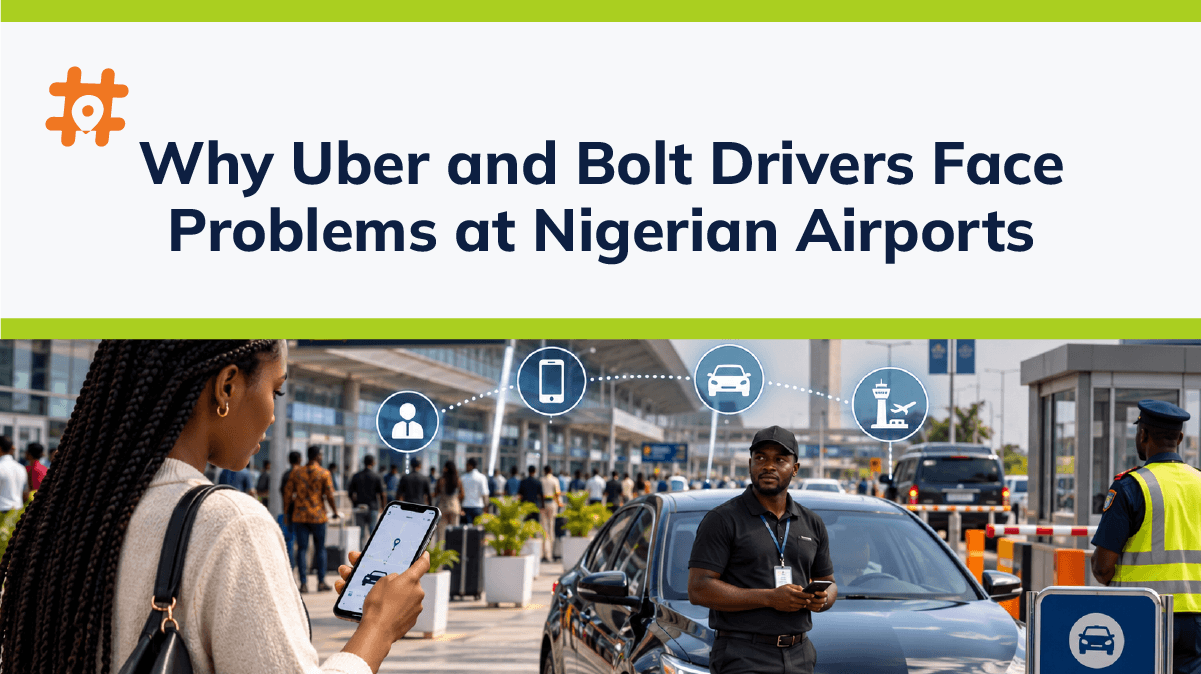
If you have recently landed at a Nigerian airport and struggled to get your usual e-hailing ride, you are not alone.
The disruption involving e-hailing services at Nigerian airports has raised questions among passengers and drivers alike. Why are drivers being stopped or restricted from picking up passengers? Has FAAN banned Uber and Bolt? Is FAAN trying to replace ride-hailing apps with its own taxi service? And what exactly is ACHRAMS?
There is an important distinction behind the controversy.
The Federal Airports Authority of Nigeria (FAAN) says it has not imposed a blanket ban on e-hailing services. Instead, it wants commercial transportation operating inside its airports to function under a framework that gives the Authority greater visibility over drivers, vehicles, pick-ups, security and accountability.
However, there is also a major development that changes the Uber side of the story: Uber discontinued its operations in Nigeria on September 2, 2026. The company said its exit followed a review of its business priorities and investment focus and was unrelated to the recent FAAN airport directive.
For passengers, though, the airport dispute is still important because Bolt and other e-hailing operators remain part of the conversation about how airport pickups should work going forward.
What actually happened between FAAN and e-hailing drivers?
The disagreement is essentially about how commercial ride-hailing vehicles should operate within a controlled airport environment.
An airport is different from an ordinary roadside pickup location. Thousands of passengers, private vehicles, taxis, buses, airline vehicles, security personnel and commercial operators may be moving through the same limited space.
FAAN’s argument is that it needs to know:
- Which driver is entering the airport?
- Which vehicle is being used?
- Which commercial operator does the vehicle belong to?
- Where is the passenger being picked up?
- Who is responsible if something goes wrong?
- How can the vehicle be identified quickly during a security incident?
- How should commercial vehicles be coordinated within airport pickup areas?
FAAN has specifically pointed to safety, security, operational visibility, accountability and the management of pickup activities as the issues behind its discussions with e-hailing platforms. It has also cited problems such as unregulated pickups and passenger solicitation.
In other words, the dispute is not simply about whether passengers should be allowed to use an app.
It is about how the driver and vehicle behind that app booking operate once they enter an airport controlled by FAAN.
Did FAAN ban Uber and Bolt from Nigerian airports?
Not as a blanket policy, according to FAAN.
On August 20, 2026, FAAN publicly clarified that it had not prohibited Uber, Bolt and other e-hailing services from Nigerian airports.
The Authority said discussions with the operators were ongoing to establish an operational framework that would allow e-hailing services to continue while meeting airport safety, security and accountability requirements.
This distinction matters because the practical experience of passengers during the disruption could certainly look like a ban.
A driver may be available elsewhere in Lagos or Abuja but be unable, unwilling or restricted from completing a pickup from a particular airport location.
So there is a difference between:
“FAAN has banned e-hailing.”
and
“E-hailing operators must comply with an airport-specific operating framework before carrying out commercial pickups within FAAN-managed airport premises.”
FAAN says the latter is what it has been pursuing.
Why is FAAN concerned about airport pickups?
The simplest way to understand FAAN’s position is visibility and accountability.
Suppose a passenger books a ride through an app.
Outside an airport, the transaction may primarily involve:
Passenger → App → Driver
Inside an airport, FAAN wants an additional layer of operational visibility:
Passenger → App/Operator → Driver/Vehicle → Airport operating framework
That allows the airport authority to establish who is operating within its premises and how commercial vehicles are moving around the airport.
FAAN has argued that this becomes particularly important in a high-security environment where incidents involving passengers, vehicles or drivers may require quick identification and investigation.
The Authority has also raised concerns about touting, passenger solicitation and random or unregulated pickups.
These are not unique concerns to ride-hailing. Airport authorities generally have to control where commercial vehicles wait, stop and collect passengers because uncontrolled activity can create congestion and security problems.
What happened at Lagos airport?
The controversy became particularly visible at Murtala Muhammed International Airport (MMIA), Lagos), where passengers experienced difficulties obtaining their usual app-based airport rides.
The disruption also triggered significant public discussion about airport taxi prices.
Reports and social-media posts circulated examples of passengers being quoted substantially higher fares for trips from the airport than they had previously paid using e-hailing services.
One widely discussed example involved a passenger reportedly being quoted ₦30,000 for a trip to Ikeja, compared with an earlier Uber fare of roughly ₦6,000–₦8,000.
It is important, however, not to treat that example as a standard airport fare. Airport transportation prices can vary based on vehicle type, operator, destination, demand and other factors.
The broader issue was that when passengers suddenly had fewer transportation choices, concerns about affordability naturally followed.
FAAN subsequently said it was responding to passenger concerns and denied that it was fixing airport taxi fares.
What is ACHRAMS?
This is probably the most misunderstood part of the entire controversy.
ACHRAMS means Airport Car Hire Rank Management System.
And according to FAAN, it is not an e-hailing app designed to compete with Uber or Bolt.
FAAN describes ACHRAMS as an airport-specific system for managing commercial car-hire operations, including digital rank, dispatch, identification and operational oversight within FAAN-managed airport environments.
Think of it this way:
Uber/Bolt
These are mobility platforms that connect passengers with drivers.
ACHRAMS
This is intended to help manage commercial airport transportation activity within the airport environment.
FAAN has explicitly stated that ACHRAMS does not seek to create a citywide driver marketplace or replace conventional e-hailing services.
That distinction is important because some online discussions made it sound as though FAAN had launched its own version of Uber.
That is not how FAAN describes ACHRAMS.
So what does ACHRAMS actually do?
According to FAAN’s explanation, the system is designed to provide greater operational visibility and tracking.
This can include linking a commercial airport trip to information about:
- The authorised operator
- The driver
- The vehicle
- The pickup
- Relevant identification and documentation
- The movement of commercial vehicles within the airport environment
- Applicable airport charges and concessions
FAAN says this creates a clearer operational trail if a passenger reports an incident or if airport authorities need to establish what happened during a particular pickup.
That is fundamentally different from building a competing consumer ride-hailing marketplace.
Why drivers are particularly affected
For passengers, the dispute is mainly an inconvenience.
For drivers, it can affect income directly.
Airport trips can be attractive because they often involve longer distances and potentially higher-value rides.
A driver who regularly picks up passengers from an airport may therefore lose a meaningful source of trips if airport access or pickup procedures change.
There are also practical issues around:
- Where drivers can wait
- Where they can collect passengers
- Whether they need additional airport registration
- Vehicle identification
- Driver verification
- Access to airport pickup areas
- Platform integration
- Applicable airport charges
- Compliance with airport operating procedures
This is why the issue is bigger than simply asking whether Uber or Bolt works on a driver’s phone.
The real question is whether the driver, vehicle and platform are properly integrated into the airport’s commercial transportation framework.
What happened with Bolt?
There has already been a significant development.
On August 27, 2026, FAAN announced that Bolt had been cleared to resume operations at FAAN-managed airports after both parties reached an operational framework.
This is important because it demonstrates that the dispute was not necessarily headed toward a permanent removal of e-hailing from airports.
Instead, the direction appears to be toward regulated integration.
FAAN said discussions with other operators were continuing at the time of its announcement.
So, for passengers, the practical lesson is that airport e-hailing availability should not be assumed to be permanently unavailable simply because there was a disruption.
The operating position can change as individual platforms reach agreements with FAAN.
What about Uber?
This is where the story has changed since the original airport controversy.
Uber is no longer operating in Nigeria.
Uber announced that it would wind down its Nigerian operations effective September 2, 2026, after reviewing its business priorities and investment focus across Africa. The company said the decision was not related to the FAAN airport directive.
Therefore, it would be inaccurate to tell Nigerian readers today that Uber is simply waiting to resolve its airport operating agreement with FAAN.
That was relevant during the August airport dispute.
It is no longer the current situation.
The distinction is important for anyone searching for:
- Uber Nigeria airport pickup
- Uber airport Nigeria
- Uber drivers in Nigeria
- Uber airport ban
- Uber and FAAN
Those searches may still bring up the airport controversy, but the subsequent nationwide exit fundamentally changed Uber’s position in the Nigerian market.

Is FAAN trying to replace Uber and Bolt with ACHRAMS?
FAAN says no.
This is one of the clearest points in its public explanation.
The Authority says ACHRAMS is not an e-hailing application and was not created to compete with or replicate Uber, Bolt or other e-hailing platforms.
The better way to understand the situation is:
FAAN wants control and visibility over commercial transportation activity at its airports.
It does not necessarily follow that FAAN wants to become the company providing every ride.
This is similar to the difference between managing a bus terminal and owning every bus that operates from the terminal.
The terminal authority establishes operating rules and manages the environment. Transport companies still provide the actual transportation service.
What does this mean for passengers?
For travellers, the biggest issue is predictability.
When you land after a long flight, you want to know:
- Where will my driver meet me?
- Can the driver enter the airport?
- Is the vehicle authorised?
- Where is the official pickup point?
- How much should the trip cost?
- What alternatives do I have if my preferred ride is unavailable?
The FAAN-e-hailing dispute shows why travellers should avoid assuming that an app booking automatically means a driver can pick you up anywhere inside an airport.
Airport operating rules can determine where and how commercial vehicles collect passengers.
A practical tip for air travellers
Before arriving at a Nigerian airport, check your ride-hailing app and the airport’s current pickup instructions.
If you are travelling during a period of operational changes, have a backup option.
For longer journeys, another practical option is to arrange your onward transport before you arrive, particularly if you have checked baggage, are arriving late at night or are travelling with family.
For travellers moving between Nigerian cities, comparing available transport options before leaving the airport can also help avoid making an expensive last-minute decision.
What does this mean for e-hailing drivers?
For drivers, the lesson is equally straightforward:
Airport trips may increasingly require more than simply being registered with an e-hailing platform.
Drivers operating commercially within airport premises should expect greater emphasis on:
- Driver identification
- Vehicle documentation
- Airport access requirements
- Approved pickup locations
- Operational tracking
- Compliance
- Passenger accountability
- Security procedures
From a driver’s perspective, that can introduce additional administration and potentially additional costs.
From FAAN’s perspective, however, those requirements are intended to make commercial transportation inside the airport more identifiable and accountable.
The long-term question will be whether the system can achieve those objectives without making airport transportation unnecessarily expensive or difficult for passengers and drivers.
That is ultimately where the success of the new framework will be judged.
The bigger issue: convenience versus airport regulation
This controversy exposes a tension that exists in many modern transport systems.
Passengers want:
Convenience + low prices + quick pickup.
Airport authorities need:
Security + accountability + traffic control + operational visibility.
E-hailing platforms are built around flexibility. A passenger can request a car and the platform matches that passenger with an available driver.
An airport, on the other hand, operates within controlled physical infrastructure.
The challenge is therefore not necessarily choosing one system over the other.
It is finding a way for digital mobility platforms and airport regulations to work together.
The Bolt agreement suggests that this is possible.
The question now is how consistently the framework will work across FAAN-managed airports and other e-hailing operators.
What travellers should watch going forward
The most important things to monitor are:
1. Airport pickup locations
Passengers should know exactly where an authorised driver is permitted to collect them.
2. Driver and vehicle identification
The more tightly commercial vehicles are integrated into airport systems, the easier it should be to identify a vehicle involved in an incident.
3. Pricing
Passengers will continue to pay close attention to airport transportation prices, particularly when e-hailing availability is limited.
4. Platform agreements
The operating position may differ between platforms depending on their agreements and compliance arrangements.
5. ACHRAMS implementation
How ACHRAMS performs in practice will matter just as much as how it is described on paper.
The real test will be whether it improves airport transportation without unnecessarily reducing passenger choice.
Final takeaway
The FAAN and e-hailing controversy is better understood as a regulatory and operational dispute rather than a simple ban on Uber and Bolt.
FAAN says it wants greater visibility over commercial vehicles and drivers operating within its airports, particularly for security, accountability, identification and orderly passenger pickup. It has also made clear that ACHRAMS is an airport transportation management system, not a replacement for e-hailing apps.
Bolt has since reached an operational agreement with FAAN and was cleared to resume airport services on August 27, 2026.
But there is an important update readers should not miss: Uber subsequently exited Nigeria entirely on September 2, 2026, and said its decision was unrelated to the FAAN dispute.
For passengers, the practical takeaway is simple: airport transportation in Nigeria is becoming more regulated, and travellers should check current pickup arrangements rather than assume that every e-hailing service operates at an airport in exactly the same way as it does elsewhere.
Frequently Asked Questions About Why Uber & Bolt Drivers Face Problems at Nigerian Airports
No. FAAN said it had not imposed a blanket ban on e-hailing services. The Authority has been working with operators on frameworks covering safety, security, accountability and airport pickup operations. Bolt was cleared to resume operations at FAAN-managed airports on August 27, 2026.
Bolt was cleared by FAAN to resume operations at FAAN-managed airports after reaching an operational agreement with the Authority on August 27, 2026. Passengers should still follow the applicable airport pickup procedures.
ACHRAMS stands for Airport Car Hire Rank Management System. FAAN describes it as an airport-specific system for managing and monitoring commercial car-hire operations. It is not intended to be a competing e-hailing application.
FAAN says airports are highly regulated environments and that commercial transportation providers need to operate under a framework that gives the Authority visibility over vehicles, drivers and activities. The stated objectives include passenger safety, security, accountability and orderly pickup management.
No. Uber discontinued its Nigerian operations effective September 2, 2026. The company said its decision followed a review of its business priorities and investment focus and was not related to the FAAN airport dispute.