


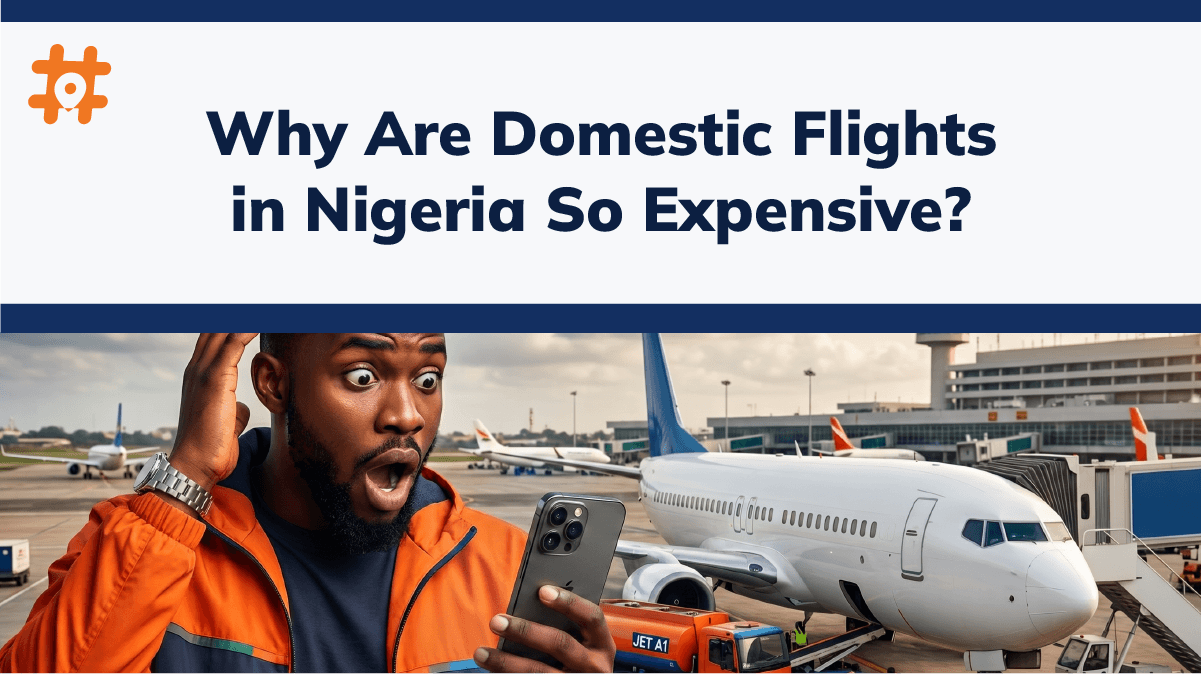
If you’ve searched for a flight from Lagos to Abuja, Port Harcourt, Enugu, Owerri or another Nigerian city recently, you may have had the same reaction:
“Why is this flight so expensive?”
It is a fair question.
For many Nigerians, flying is no longer simply about paying for a seat on an aircraft. The price of that seat reflects a long chain of costs, aviation fuel, aircraft maintenance, leasing or ownership, foreign exchange exposure, airport and regulatory charges, insurance, staffing and the number of seats available to spread those costs across.
And there is another factor passengers often don’t see:
Airlines can face significantly higher operating costs in Nigeria while still operating in a market where customers are highly sensitive to price.
In 2026, that pressure has become particularly visible. Nigerian airlines have faced sharp increases in Jet A1 prices, while industry experts have also pointed to limited aircraft capacity, maintenance constraints, financing costs and airport charges as contributors to high fares.
So, are Nigerian airlines simply making flights unnecessarily expensive?
Not necessarily.
The reality is more complicated.
Let’s look at what actually determines the price of a flight in Nigeria—and what travelers can do to get better value when booking.
Why Are Flights in Nigeria So Expensive?
The short answer is that airline tickets reflect the cost of operating an aircraft, and several of those costs are unusually difficult or volatile in Nigeria.
The biggest factors include:
- High aviation fuel costs
- Foreign exchange pressure
- Aircraft maintenance costs
- Aircraft leasing and financing
- Airport and aviation charges
- Limited aircraft capacity
- Demand and seat availability
- Taxes, fees and other operating expenses
These factors don’t operate independently.
One can make another more expensive.
For example, if an airline has fewer operational aircraft, there are fewer seats available. If demand remains strong, those seats become more valuable. At the same time, the airline still has to recover fuel, maintenance, financing and airport costs.
That is how an apparently simple one-hour flight can become expensive to operate.
1. Aviation Fuel Is One of the Biggest Reasons Flights Are Expensive
If there is one cost travelers should understand when discussing Nigerian airfares, it is Jet A1.
Jet A1 is the aviation fuel used by commercial aircraft.
And aircraft consume a lot of it.
When the price of aviation fuel rises significantly, airlines face an immediate increase in operating costs.
In April 2026, Nigerian operators said aviation fuel had become their most burdensome operating cost, with industry representatives putting its share at around 40% of total expenses for some domestic airlines, well above the global average cited by IATA.
The situation became particularly severe during 2026.
BusinessDay reported that Jet A1 prices had risen from below ₦900 per litre at the end of 2023 to ranges above ₦2,000 per litre in parts of Nigeria during 2026.
That difference is enormous.
Imagine running a business where one of your biggest inputs suddenly becomes two or three times more expensive.
You either:
- Absorb the additional cost
- Increase prices
- Reduce operations
- Find ways to use less of the expensive input
Airlines face the same basic economic problem.
2. The Naira and Foreign Exchange Affect Airline Costs
Aviation is an international business.
Even when your flight is completely within Nigeria, many of the costs behind that flight are connected to foreign currencies.
Aircraft may be:
- Leased internationally
- Insured internationally
- Maintained using imported parts
- Supported by international suppliers
- Financed through foreign-currency arrangements
Aircraft components and specialised aviation services can also have international pricing exposure.
This means that a weaker naira can increase an airline’s costs even if the aircraft never leaves Nigerian airspace.
That is one reason foreign exchange pressure matters when trying to understand Nigerian airfare.
It isn’t simply:
Naira goes down → airline increases ticket price.
The relationship is more complicated.
But when an airline’s dollar-linked costs rise while its revenue is primarily earned in naira, its financial pressure increases.
3. Aircraft Maintenance Is Expensive
An aircraft cannot simply be treated like a regular vehicle that goes to a mechanic when something starts making a strange noise.
Commercial aircraft operate under strict maintenance and airworthiness requirements.
Inspections, scheduled maintenance, spare parts, technical staff and repairs all cost money.
And when aircraft components need to be sourced internationally, foreign exchange can become part of the equation.
This matters because airlines have to maintain aircraft whether passenger demand is strong or weak.
An aircraft sitting on the ground still represents an investment.
If maintenance takes longer than expected, the airline can also lose available capacity.
That brings us to another major factor in Nigerian airfares.
4. Nigeria Has a Capacity Problem
One of the most overlooked reasons flights become expensive is how many aircraft and seats are actually available.
Think about it like this.
Imagine 10,000 people want to travel on a route, but airlines collectively have enough seats for only 6,000 passengers.
Those seats become more valuable.
The same principle applies to airline pricing.
Industry experts speaking in January 2026 highlighted limited operational capacity, grounded aircraft and maintenance delays as important contributors to high Nigerian airfares. One industry presentation cited only 44 operational aircraft against 79 grounded aircraft in 2025.
When fewer aircraft are available:
- There are fewer seats
- Competition can weaken
- Popular flights fill faster
- Remaining seats become more expensive
- Airlines have fewer opportunities to spread fixed costs
This is why simply saying “there should be more airlines” doesn’t completely solve the problem.
The industry needs enough operational aircraft, reliable maintenance capacity, financing and sustainable operations to create meaningful seat capacity.
5. Airport and Aviation Charges Add to the Cost
Passengers often see one figure when searching for a flight.
The airline sees a much bigger cost structure behind that ticket.
Airlines can face charges associated with:
- Airport use
- Landing
- Parking
- Passenger services
- Navigation
- Security
- Regulatory requirements
- Ground handling
- Other aviation services
Industry stakeholders have repeatedly raised concerns about the cumulative burden of aviation-related charges in Nigeria.
In 2026, BusinessDay reported an industry estimate that combined charges from agencies including NCAA, FAAN and NAMA could account for a substantial share of airline revenues. The exact burden varies by airline, route and charge structure, so such industry estimates should not be interpreted as a universal percentage for every carrier.
The important point is simpler:
An airline doesn’t keep every naira you pay for a ticket.
A significant portion of its revenue goes toward operating the flight and meeting the costs associated with the aviation system.
6. Airlines Have to Recover Aircraft Leasing and Financing Costs
Aircraft are expensive assets.
And airlines don’t always own every aircraft they operate outright.
Some aircraft are leased.
Others may involve financing arrangements that require regular payments.
These costs continue regardless of whether every seat is sold.
Consider a simplified example.
An aircraft has 150 seats.
If 150 passengers travel, the airline can spread its operating costs across 150 tickets.
If only 60 passengers travel, the airline still has to operate the aircraft.
The cost doesn’t suddenly become one-third.
The cost per passenger becomes higher.
This is one reason load factor and seat utilisation matter so much to airline economics.
7. Low Passenger Demand Can Actually Make Flights More Expensive
This sounds counterintuitive.
You might think:
“If fewer people are flying, shouldn’t airlines lower their prices?”
Not necessarily.
Airlines have many costs that don’t disappear when passenger numbers fall.
If a flight operates with fewer passengers, the airline has fewer passengers contributing toward the cost of:
- Fuel
- Crew
- Aircraft
- Airport charges
- Maintenance
- Insurance
- Ground operations
This creates a difficult balance.
Lower prices might encourage demand, but if prices fall too far, the airline may lose money on the flight.
That is why airlines have to balance price, demand and capacity.
8. Peak Travel Periods Push Prices Higher
Even in markets where operating costs remain relatively stable, airfare can change dramatically depending on demand.
This is especially noticeable around:
- Christmas and New Year
- Easter
- Major public holidays
- School holidays
- Major conferences
- Large events
- Popular travel periods
When more people want the same seats, cheaper fare classes can sell out.
Once those lower-priced seats are gone, travelers see higher fares.
This is why two people can search the same route and see different prices depending on:
- Date
- Time
- Booking window
- Seat availability
- Fare class
- Demand
The aircraft hasn’t necessarily become more expensive to operate overnight.
The available inventory has changed.
Why Does the Same Flight Cost Different Amounts?
This is one of the most confusing things about airline pricing.
You might search a Lagos-to-Abuja flight today and see:
₦150,000
Then search again later and see:
₦180,000
Or another traveler may have purchased the same flight for less.
That doesn’t automatically mean someone was overcharged.
Airlines typically sell seats in different fare categories.
For example, an aircraft might have a limited number of seats available at a lower fare.
Once those seats sell, the next available fare category may be higher.
So:
Same aircraft ≠ same fare
and
Same route ≠ same price
This is why booking early can sometimes help, although it is not a guarantee that an early booking will always be cheaper.
Are Nigerian Airlines Making Too Much Profit From Expensive Tickets?
This is where the conversation often becomes too simplistic.
Passengers understandably focus on the amount they pay.
But a high ticket price does not automatically mean a high airline profit margin.
Recent industry commentary has highlighted the opposite problem: airlines are facing substantial increases in fuel and other operating costs while demand remains sensitive to higher fares.
In June 2026, Air Peace’s CEO Allen Onyema said Nigerian airlines were increasingly relying on bank loans to sustain operations as fuel and borrowing costs placed pressure on their businesses.
This doesn’t mean every airline is financially struggling or that passengers should accept every fare without question.
It means that ticket price and airline profit are two different things.
A ₦200,000 ticket does not mean ₦200,000 goes into the airline’s pocket.

Why Are Domestic Flights Sometimes More Expensive Than Expected?
A common reaction from Nigerian travelers is:
“How can a one-hour flight cost this much?”
The answer is that you’re not paying only for the time the aircraft spends in the sky.
You’re paying for access to a highly regulated, capital-intensive transportation system.
Your ticket contributes toward the cost of:
- Aircraft
- Fuel
- Pilots
- Cabin crew
- Engineers
- Maintenance
- Insurance
- Airports
- Navigation
- Security
- Ground operations
- Technology
- Administration
- Financing
- Regulatory compliance
The aircraft may be in the air for only one hour.
But the infrastructure required to make that one-hour flight possible operates around the clock.
Why Lagos-to-Abuja Flights Can Become Expensive
Lagos-Abuja is one of Nigeria’s busiest domestic aviation corridors.
That means there is strong demand—but also strong operating pressure.
Prices can rise when:
- Popular departure times fill quickly
- Lower fare classes sell out
- Fuel costs increase
- Aircraft availability falls
- Travel demand rises
- Booking happens close to departure
This is why there isn’t one permanent Lagos-to-Abuja flight price.
If you’re planning this route, compare the actual fares available on your travel date instead of relying on an old price you saw online.
Why Flight Prices Can Change So Quickly
Airfare is dynamic.
A flight that costs one amount today can cost another amount tomorrow.
Several variables can influence this:
Demand
More people searching for the same flight can increase the price of remaining seats.
Availability
Fewer available seats usually means fewer low-fare options.
Travel date
Peak dates are often more expensive.
Departure time
Some flights may be more popular than others.
Booking window
Prices can change as the departure date approaches.
Competition
Where several airlines serve the same route, competition can influence pricing.
Operating costs
Fuel, foreign exchange and other airline expenses can affect pricing decisions.
So, Will Flights in Nigeria Become Cheaper?
There is no guaranteed answer.
Airfares could come under pressure if some of the major cost drivers improve.
For example:
- More stable aviation fuel supply
- Lower fuel prices
- Greater aircraft availability
- Improved maintenance capacity
- More predictable foreign exchange
- Lower or more efficient aviation charges
- Stronger competition
- Better airline economies of scale
There have already been interventions aimed at stabilising aviation fuel supply and pricing. In April 2026, NMDPRA announced benchmarked Jet A1 prices for Lagos and Abuja and directed marketers to sell directly to airline operators, with the stated aim of improving supply efficiency and pricing transparency.
But lower operating costs do not automatically translate into immediately cheaper tickets.
Airlines also need to recover previous losses, maintain aircraft, service financing obligations and manage future costs.
So the relationship between lower fuel prices and lower airfares isn’t always immediate.
How Can You Get Cheaper Flights in Nigeria?
This is the part passengers can actually control.
You can’t control Jet A1 prices.
You can’t control the naira exchange rate.
You can’t control airport charges.
But you can control how you search and when you book.
1. Compare Multiple Airlines
Don’t assume your preferred airline will always have the cheapest fare.
Compare the airlines operating your route.
A small difference in fare can become significant if you’re booking for several passengers.
2. Compare Different Travel Dates
If your schedule allows it, search more than one date.
A flight on Friday afternoon may have completely different demand from one on Tuesday morning.
Flexibility can be one of the simplest ways to find better fares.
3. Compare Departure Times
Don’t look only at the cheapest flight.
Consider whether the departure time works for you.
A slightly more expensive flight that saves you from paying for additional transport or accommodation may actually offer better overall value.
4. Book Before the Cheapest Fare Classes Disappear
There’s no universal rule saying:
“Book exactly 30 days before your flight.”
Airline pricing doesn’t work that neatly.
But if you already know your travel date, searching earlier gives you more opportunities to compare available fare categories.
Waiting until the last minute can leave you with fewer seats and fewer fare options.
5. Compare the Total Cost, Not Just the Ticket
Look at:
Ticket + baggage + airport transportation + other travel costs
A flight that appears ₦10,000 cheaper may not actually be cheaper if it comes with different baggage conditions or a much less convenient schedule.
A Smarter Way to Buy Flights in Nigeria
The biggest mistake travelers make is searching for “the cheapest flight” rather than searching for “the best-value flight.”
Those are not always the same thing.
When comparing flights, look at:
| Factor | Why It Matters |
|---|---|
| Ticket price | Determines your immediate cost |
| Baggage | Extra charges can change the final price |
| Departure time | Affects your schedule |
| Arrival time | Important for meetings and onward travel |
| Airline | Service and route availability differ |
| Flexibility | Important if plans may change |
| Connection | Matters for international journeys |
| Total travel cost | Gives you a realistic comparison |
If you’re planning a domestic or international trip, Intercity allows travelers to search and compare available flight options before booking.
Instead of choosing based on one advertised fare, compare the available airlines, schedules and prices for your actual travel date.
That is a much more reliable way to find value.
Are Flights Still Worth the Money?
Sometimes, absolutely.
The comparison shouldn’t always be:
“₦200,000 flight vs ₦50,000 bus.”
It should sometimes be:
“What is six, eight or ten hours of my time worth?”
For a business traveler with a meeting in Abuja, spending more on a flight may make financial sense.
For a student traveling home with a flexible schedule, a bus may be the better option.
For someone attending an important event, the shorter journey may justify the higher fare.
For someone traveling on a tight budget, the additional cost of flying may not be worthwhile.
The right answer depends on the traveler.
The Bigger Problem Behind Expensive Flights in Nigeria
Nigeria’s airfare problem isn’t caused by one thing.
It is a combination of cost, capacity, infrastructure, financing, fuel, foreign exchange and demand.
That is why there isn’t a single policy that can instantly make domestic flights cheap.
Reducing fuel costs helps.
Increasing aircraft availability helps.
Improving maintenance infrastructure helps.
Reducing unnecessary charges helps.
Improving competition helps.
Creating a more predictable operating environment helps.
But sustainable affordability requires several of these improvements to happen together.
What Travelers Should Take Away
The next time you see a ₦200,000 or higher domestic flight, it is reasonable to question the price.
But it is also worth understanding what sits behind that number.
The airline isn’t simply charging you for the hour you spend in the air.
You’re paying into an expensive system involving fuel, aircraft, people, maintenance, airports, regulation, financing and infrastructure.
And when those costs rise while available aircraft and seats remain limited, the pressure eventually reaches the passenger.
That doesn’t mean you should stop comparing prices.
Quite the opposite.
Understanding why flights are expensive makes comparing flights even more important.
Final Thoughts: Why Flights in Nigeria Are Expensive
So, why are flights in Nigeria so expensive?
The answer is not simply “because airlines want to charge more.”
High aviation fuel costs, foreign exchange pressure, aircraft maintenance, leasing and financing, airport charges, limited capacity and changing passenger demand all contribute to the final price. Recent 2026 industry reporting shows just how significant these pressures have become, particularly around Jet A1 and available aircraft capacity.
For travelers, the practical lesson is straightforward:
You may not be able to control the cost of aviation in Nigeria, but you can control how you shop for your flight.
Compare airlines.
Compare dates.
Compare departure times.
Check baggage rules.
Look at the total cost.
And don’t assume the first price you see is the best price available.
Planning your next flight?
Search your route on Intercity, compare available domestic or international flight options, and choose the fare and schedule that offer the best value for your journey.
Because when flights are expensive, smart comparison matters even more.
Frequently Asked Questions About Why Are Flights in Nigeria So Expensive? 8 Key Reasons
Flights in Nigeria are expensive because airlines face several high and volatile operating costs, including aviation fuel, aircraft maintenance, foreign exchange exposure, aircraft leasing or financing, airport-related charges and limited aircraft capacity. Recent industry reports have identified fuel and capacity constraints as particularly important factors.
Domestic flights can be expensive because Nigerian airlines still have to cover many of the same major operating costs regardless of how short the route is. Fuel, aircraft maintenance, crew, airport charges, financing and limited seat capacity all contribute to the cost of operating a domestic flight.
Airfare can change because airlines sell seats at different fare levels. As cheaper fare categories sell out, the remaining seats can become more expensive. Demand, travel dates, seat availability, competition, operating costs and how close you are to departure can all influence the price.
Compare multiple airlines, search flexible travel dates, consider different departure times and book early enough to have more fare options. Also compare the complete cost, including baggage and transportation to and from the airport, rather than looking only at the advertised ticket price.
They could become more affordable if major cost pressures such as aviation fuel, aircraft maintenance, foreign exchange exposure and capacity constraints improve. However, lower operating costs do not necessarily translate immediately into lower ticket prices because airlines also need to recover costs and maintain financially sustainable operations.
Related Articles
What’s the Cheapest Way to Fly Within Nigeria? | Save Money on Domestic Flights (2026)
What Should I Do If I Miss My Flight? A Step-by-Step Recovery Guide (2026)