


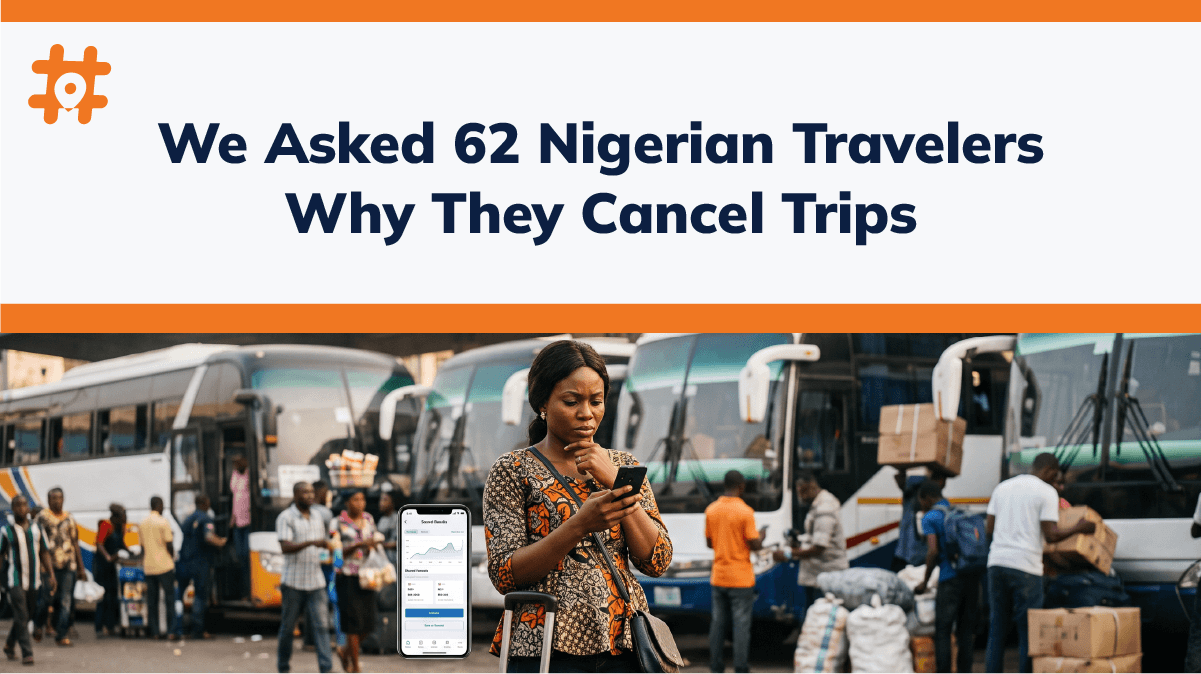
You book a trip in the morning.
By afternoon, you’ve cancelled it.
Sound familiar?
For many of the travelers Intercity spoke with in Lagos, it isn’t an unusual situation. In fact, in our first round of field interviews, 8 out of 10 people said they had cancelled a trip.
Not once, years ago and forgotten.
Some had cancelled recently. Some had done it more than once. A handful said they had cancelled three or more trips.
So Intercity went to motor parks across Lagos with one simple question:
Have you ever cancelled a trip?
The answer was clear.
But the bigger surprise was why.
Field Notes
Research focus: Bus trip cancellations among Nigerian travelers
Location: Motor parks across Lagos
Travelers interviewed so far: 62
Headline question: “Have you ever cancelled a trip?”
Research status: Ongoing
Next focus: Refunds, cancellation fees and the post-cancellation experience
Important: These findings are based on field interviews with 62 travelers in Lagos so far. They are not intended to represent all Nigerian travelers or serve as a nationally representative survey. Intercity is continuing the research and will update the findings as more interviews are conducted.
It’s About the Money, Not the Operator
The biggest reason travelers gave for cancelling was surprisingly straightforward:
Price.
About half of the travelers who had cancelled pointed to one of two things: the fare changed, or they found a cheaper option somewhere else.
Not bad service.
Not a terrible driver.
Not necessarily a bad experience with the transport company.
Price.
That matters more than it might initially seem.
It suggests that booking a bus ticket isn’t always the final decision. For some travelers, the decision remains open until the journey actually happens.
A cheaper option appearing later can be enough to make someone reconsider an existing booking.
The traveler may have already selected an operator, chosen a departure time and made plans around the journey.
But if the economics change, the decision can change too.
In that sense, cancellation isn’t always about rejecting a company.
Sometimes, it’s simply about finding an option that makes more sense at that particular moment.
Plans Change Too
Price wasn’t the only major reason travelers gave us.
Changing plans was another recurring theme.
A date stops working.
A trip is no longer necessary.
A work commitment changes.
Something unexpected comes up.
The journey that made sense when the ticket was booked may no longer make sense a few hours or days later.
And none of that necessarily has anything to do with the transport operator.
It’s just life happening after the booking button has been clicked.
That distinction is important because a cancellation can easily be interpreted as a sign that something went wrong.
But the conversations we had suggest that’s not always the case.
Sometimes, the traveler simply no longer needs the ticket they bought.
Most Cancellations Weren’t About Bad Experiences
Here’s one of the more interesting things we heard.
Almost nobody in this first batch of interviews said they cancelled because of a bad experience with an operator.
That doesn’t mean service quality doesn’t matter to travelers.
It means that, among the people we spoke with, service dissatisfaction wasn’t the main explanation for cancellation.
There’s a real difference between:
“I don’t want to ride with this company again.”
and:
“My circumstances changed, so this particular booking no longer works for me.”
Based on what Intercity heard in this first round, the second situation appeared far more common.
For transport operators, that’s an important distinction.
A cancellation doesn’t automatically mean a traveler has lost confidence in the company.
Sometimes, the traveler is simply making a different decision about one particular journey.
Some Travelers Had Cancelled More Than Once
Cancellation also wasn’t always a one-time event.
Some travelers we interviewed said they had cancelled multiple trips.
A handful reported cancelling three or more trips.
That doesn’t mean every Nigerian traveler frequently cancels a bus journey.
But it does suggest something worth looking at more closely:
Cancellation may be a recurring part of how some travelers manage changing prices and changing plans.
Instead of being a rare exception, it can become part of the normal decision-making process around travel.
And that raises a more important question.
The Real Story Starts After You Hit Cancel
Knowing why people cancel was only step one.
The next question is what happens after someone actually cancels.
Do they get their money back?
How long does it take?
Is there a cancellation fee?
Did the traveler know about the fee before booking?
Do they have to call somebody?
Send a message?
Visit an office?
Or does the refund simply happen without the traveler having to chase anyone?
And perhaps the question that matters most for transport operators:
Does the cancellation experience influence where that traveler chooses to book next time?
Because a cancellation policy can look like ordinary fine print when you’re booking a ticket.
Until you’re the person waiting for your money back.
Then the cancellation policy becomes part of the customer experience.
A Cancellation Policy Is More Than Fine Print
For a traveler, the booking experience doesn’t necessarily end when they receive a ticket.
It can continue through changes, cancellations and refunds.
A traveler who cancels may remember:
- How easy it was to cancel
- Whether the rules were clear
- Whether a fee was involved
- How much money they received back
- How long the refund took
- Whether they had to contact customer support
- Whether they felt they were being kept informed
Those experiences can shape how a traveler thinks about the company afterward.
That’s why Intercity’s next phase of research is moving beyond why people cancel and into what happens when they do.
The Obvious Caveat
We think the findings are interesting.
But we’re also clear about what they don’t tell us.
62 travelers in Lagos motor parks is not a national survey.
These are field interviews, not a scientifically representative sample of every Nigerian traveler.
The findings therefore shouldn’t be read as:
“This is what all Nigerians do.”
Instead, they should be understood for what they are:
a snapshot of what the travelers we spoke with told us.
That’s why we’re continuing the interviews.
Rather than treating a small initial sample as the final answer, Intercity plans to keep collecting responses and update the findings as the research grows.
What We Know Now
So far, three things stand out.
1. Cancellation was common among the travelers we interviewed
Around 8 in 10 of the 62 travelers we spoke with said they had cancelled a trip.
2. Price was the biggest reason
About half of the travelers who had cancelled pointed to a fare change or finding a cheaper alternative.
3. Bad operator experiences were rarely the reason
Very few of the travelers interviewed said they cancelled because of poor service or a bad experience with the operator.
Together, those findings give us a different way to look at trip cancellation.
Cancellation isn’t automatically a verdict on the operator.
For many of the travelers we spoke with, it was a response to price and changing circumstances.
The Question Has Changed
At the beginning of this research, the question seemed straightforward:
Why do people cancel trips?
After talking to travelers, we think there’s a more useful question:
What happens to travelers after they cancel?
Because the cancellation itself may only be one part of the experience.
What happens to their money could matter just as much.
And the ease—or difficulty—of getting that money back could influence what happens the next time they need to travel.
What’s Next?
Intercity is spending the next few weeks digging deeper into the cancellation experience.
The next phase of our field research will focus on:
Refunds
Do travelers actually get their money back after cancelling?
Waiting times
How long do they have to wait before receiving a refund?
Cancellation fees
Are travelers charged for cancelling, and did they understand those charges before booking?
The cancellation process
Can travelers cancel easily, or do they need to contact someone or take additional steps?
Trust and future bookings
After going through the cancellation and refund process, would they book with the same company again?
These are the questions we’re taking back to travelers.
And as the research grows, we’ll continue updating what we’ve learned.
What Nigerian Travelers Told Us
The numbers are useful.
But the conversations behind them are even more valuable.
A cancellation can look like a simple action on a booking system.
For the traveler, it can represent a change in plans, a change in finances or an entirely different decision about how to make the journey.
That’s why Intercity’s approach is to keep asking travelers directly.
Rather than guessing what travelers want, we’re going to the places where they travel and asking them.
The first question was about cancellation.
The next questions are about what happens afterward.
Frequently Asked Questions About why Nigerians cancel bus trips
Based on Intercity’s first round of field interviews, price was the biggest reason. About half of the travelers who had cancelled pointed to a fare change or finding a cheaper alternative. Changing personal plans was another major reason.
Around 8 in 10 of the 62 travelers interviewed said they had cancelled a trip. This finding applies specifically to the travelers included in this first round of field interviews and is not a claim about all Nigerian travelers.
Rarely, based on this first sample. Very few of the travelers we spoke with identified a bad experience with an operator as their reason for cancelling. Price and changing plans came up much more frequently.
It depends on the operator and the terms attached to the ticket. A traveler may need to consider whether the ticket is refundable, whether a cancellation fee applies and how the refund is processed. Intercity is currently researching travelers’ real experiences with these processes.
No. This is ongoing field research that began with interviews at motor parks across Lagos. There are 62 travelers in the first round so far. The findings reflect what those specific travelers told Intercity and should not be treated as a nationally representative statistic.
Planning Your Next Trip?
Travel plans can change.
When they do, having clear information about your options can make the journey easier to manage.
Intercity brings different travel options together so you can search, compare and choose an option that works for your journey.
Search your next journey with Intercity.
Research Update
First published: September 2026
Initial interviews: 62 travelers across Lagos
Research status: Ongoing
Research focus: Trip cancellations, refunds and the post-cancellation experience
Next update: As additional traveler interviews are completed
This article will be updated as Intercity’s field research continues.