

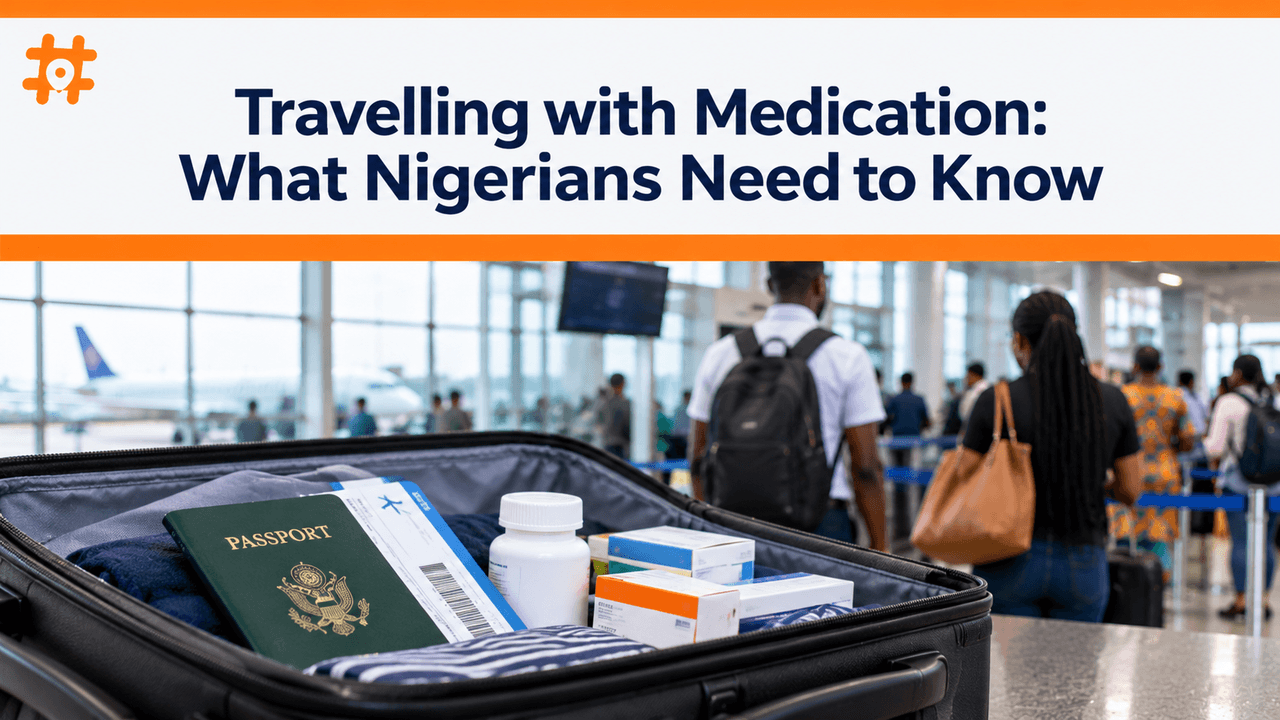
THE MEDICINE IN YOUR BAG COULD GET YOU INTO TROUBLE AT THE AIRPORT
Imagine travelling from Nigeria to another country with your personal belongings, including medication you regularly use. You have your passport, visa, flight ticket and other travel documents. You have also packed your medicine, assuming that because it was legally purchased in Nigeria, there should be no problem carrying it abroad.
But what happens when airport authorities discover that the medicine contains an ingredient classified as a controlled substance in your destination country?
For some travellers, this can result in additional questioning, confiscation of medication, travel delays or more serious legal complications.
This is not simply a hypothetical situation. In 2018, a Nigerian student named Zainab Aliyu was detained in Saudi Arabia after Tramadol was discovered in luggage bearing her name.
Her experience exposed a serious issue that every international traveller should understand: what you carry in your luggage matters, and the laws governing medication can differ significantly between countries.
Whether you are travelling to the United Kingdom, United States, Canada, United Arab Emirates or Saudi Arabia, understanding the rules surrounding medication should be part of your travel preparations.
Here is what Nigerian travellers need to know before packing their medicines.
Why the Medicine in Your Bag Could Become a Problem at the Airport
The biggest misconception about travelling with medication is that anything legally available in Nigeria is automatically permitted in another country.
This is not true.
Every country has its own laws governing pharmaceutical products, prescription medicines, narcotic substances and controlled drugs.
A medicine that can be purchased from a Nigerian pharmacy may contain an active ingredient that another country regulates more strictly.
For example, some painkillers, sleeping tablets and prescription medications contain substances that may fall under international drug-control regulations or national controlled-medicine legislation.
Understanding the difference between these classifications is important.
Types of medication travellers should understand
1. Generally permitted medicines
These are medicines that can ordinarily be carried for personal use, subject to applicable import and security requirements.
Examples may include common pain relief, vitamins and certain cold or allergy medications.
However, their classification should still be checked before international travel.
2. Prescription-only medicines
These are medicines that require authorisation from a qualified healthcare professional before they can be dispensed.
Having a prescription helps demonstrate legitimate medical use, but it does not automatically guarantee that another country will permit the medicine’s importation.
3. Controlled or restricted medicines
These contain active ingredients that are subject to additional legal controls because of their potential for dependence, misuse or other regulatory concerns.
Examples can include certain opioids, sedatives, stimulants and psychotropic medicines.
Depending on the destination, travellers may need a prescription, medical report, import permit or advance authorisation.
4. Prohibited medicines
These are products or substances that a country does not permit travellers to import under ordinary personal-use arrangements.
Some may be prohibited completely, while others may be permitted only under specific licensing or medical exceptions.
The important point is that a medicine’s legal status depends on the laws of the country you are entering, not simply where you purchased it.
Medicines You Should Check Before Travelling Internationally
Some medication categories deserve additional attention before travelling because their active ingredients may be controlled or restricted in certain countries.
Tramadol and other strong painkillers
Tramadol is a prescription pain medicine used to manage moderate to severe pain.
Although it has legitimate medical applications, it is controlled in various jurisdictions because of its potential for dependence and misuse.
The Zainab Aliyu incident demonstrates why travellers should take its international classification seriously.
Other strong painkillers, including medicines containing morphine, oxycodone and similar opioid ingredients, may also be subject to strict controls.
Before travelling with these medicines, confirm whether they are permitted, whether advance approval is required and what quantity you can legally carry.
Codeine-containing medicines
Codeine is found in some prescription painkillers and cough preparations.
Its classification differs between countries and can depend on the formulation, concentration and quantity.
A cough medicine purchased from a Nigerian pharmacy should therefore not automatically be assumed to be acceptable abroad.
Check the active ingredients rather than relying only on the product’s brand name.
Sleeping pills and sedatives
Some medicines prescribed to manage insomnia, anxiety and other conditions contain controlled substances.
Certain benzodiazepines and other sedatives may be regulated under national drug-control laws.
If you regularly use sleeping medication, ask your doctor or pharmacist to identify its active ingredients and confirm whether additional travel documentation is necessary.
ADHD and other prescription medications
Certain ADHD medications contain stimulant ingredients, including methylphenidate and amphetamine-based substances.
Some countries regulate these medicines as controlled drugs.
Other prescription medicines used for neurological, psychiatric and chronic health conditions may also require additional documentation.
Do not assume that a medication is permitted simply because it was prescribed by a qualified Nigerian doctor.
Common over-the-counter medicines
Even medicines available without a prescription in Nigeria can present problems abroad.
Some cold, flu and decongestant products contain ingredients that are restricted or regulated in particular countries.
Pseudoephedrine-containing products are an example of ingredients that may attract additional import controls.
Before packing over-the-counter medicines, check the ingredients and destination-country requirements.
Can You Travel with Prescription Medication from Nigeria?
Yes. In many circumstances, travellers can carry prescription medication from Nigeria for their personal medical needs. However, permission depends on the medication, quantity, destination and applicable import regulations.
A prescription is an important supporting document because it helps demonstrate that the medicine is being carried for legitimate medical treatment.
Nevertheless, a prescription issued in Nigeria does not automatically override another country’s drug laws.
For example, a medicine may be prescribed by a Nigerian doctor but classified as a controlled substance by the country you are visiting.
In such circumstances, additional requirements may apply.
Before departure, establish the following:
- Whether the medicine is legally permitted in your destination.
- Whether it contains a controlled substance.
- Whether a doctor’s prescription is sufficient.
- Whether a medical report is required.
- Whether an advance import permit is necessary.
- Whether there are restrictions on the quantity you can carry.
- Whether the medication is permitted in any country where you will transit.
If you need medication for a chronic condition, begin these checks early. This gives you time to obtain the necessary documents or discuss alternative treatment arrangements with your doctor.
Countries Where Medication Rules Require Extra Attention
Different countries have different approaches to regulating medicines brought in by international travellers.
The following comparison highlights important requirements Nigerian travellers should investigate.
| Destination | Medication-related restrictions | Documentation or authorisation to check |
|---|---|---|
| Saudi Arabia | Narcotic and psychotropic medicines are regulated and require controlled-drug clearance procedures. | SFDA Controlled Drugs System, medical report, prescription and applicable supporting documents. |
| UAE | Narcotic and psychotropic medicines are controlled. Visitors may carry qualifying personal-use quantities subject to regulatory conditions. | Prescription, medical report and optional advance electronic approval through the Emirates Drug Establishment. |
| United Kingdom | Controlled medicines are subject to specific personal-import rules and quantity limits. | Doctor’s letter or prescription, medicine details and applicable licence requirements. |
| United States | Prescription and OTC medicines are subject to US federal importation rules. Controlled substances have additional DEA requirements. | Prescription or doctor’s letter, original packaging, declaration where applicable and confirmation of admissibility. |
| Canada | Controlled prescription medicines are subject to specific personal-use and quantity requirements. | Prescription, properly labelled healthcare-provider container and compliance with the 90-day supply limit. |
Important: These are summaries of selected official requirements, not blanket permission to carry every medicine in each country.
Saudi Arabia
Saudi Arabia deserves particular attention because of the Zainab Aliyu incident and its strict controls on certain medicines.
The Saudi Food and Drug Authority (SFDA) regulates the importation and clearance of controlled medicines.
On 14 August 2025, the SFDA published guidance explaining how travellers can obtain clearance permits for controlled medicines containing narcotic or psychotropic substances.
The process uses the Saudi Controlled Drugs System:
Travellers can create an account, submit their travel and patient information, provide details of their medication and upload supporting documents such as prescriptions, medical reports and identification.
The system also allows applicants to monitor their application status.
The International Narcotics Control Board’s Saudi Arabia country information provides additional guidance on prescriptions, medical documentation, quantities and disclosure requirements.
Do not rely on an old online article when travelling to Saudi Arabia with controlled medication. Check the current SFDA requirements for the exact medicine before departure.
United Arab Emirates
The UAE regulates narcotic and psychotropic medicines brought into the country for personal use.
The Emirates Drug Establishment provides an electronic service through which travellers can obtain advance approval for controlled medicines.
According to its published guidance, advance approval is optional for qualifying visitors, who may carry up to three months’ supply of controlled medication, provided the applicable requirements are met.
Travellers should carry the prescription and medical report. The prescription should identify the patient, medicine, dosage and treatment details, and the required supporting documentation should be properly authenticated by the relevant healthcare authority.
The official service is available here:
https://www.ede.gov.ae/en/w/issue-of-permit-to-import-medicines-for-personal-use
The UAE’s rules should not be confused with Saudi Arabia’s procedures. Each country has its own regulatory system.
United Kingdom
The United Kingdom permits visitors to bring certain prescribed controlled medicines for personal use, subject to specific conditions.
The Home Office provides a personal-import framework that generally permits qualifying Schedule 2 to 4 Part I controlled medicines in quantities of up to three months’ supply.
Travellers must be able to demonstrate that the medication was lawfully prescribed and dispensed to them.
A doctor’s letter should identify the patient, medicines, doses, strengths and frequency of use.
The UK also requires controlled medicines to be carried in hand luggage when entering or leaving the country.
Certain Schedule 1 substances require a licence and cannot be brought in under ordinary personal-use arrangements.
Official guidance:
https://www.gov.uk/guidance/controlled-drugs-personal-licences
United States
The United States applies its own rules to medicines entering the country, regardless of whether they were legally prescribed abroad.
The Food and Drug Administration (FDA) regulates the importation of medicines, while the Drug Enforcement Administration (DEA) regulates controlled substances.
US Customs and Border Protection (CBP) also handles border inspections and declarations.
For ordinary personal medication, visitors should carry supporting medical documentation and retain the original packaging.
For controlled substances, additional DEA requirements apply. A foreign prescription alone does not establish that a controlled substance is admissible.
Travellers should confirm the applicable rules before departure rather than assuming that all medicines prescribed in Nigeria can enter the United States.
Official starting points:
https://www.fda.gov/industry/import-basics/personal-importation
Canada
Canada has specific requirements for travellers entering or leaving the country with prescription medicines containing controlled substances.
Health Canada’s published guidance generally allows qualifying travellers to carry up to 90 days’ supply, calculated using their usual daily dosage.
The medicine must be prescribed by an authorised healthcare practitioner and carried in a properly labelled container obtained from a healthcare provider.
The label must include information such as the patient’s name, prescriber’s name, medicine name, daily dosage, strength and quantity.
The medication must be for the traveller’s personal medical use or for someone they are responsible for who is travelling with them.
Official guidance:
What Happened in Zainab Aliyu’s Case? Lessons About Airport Luggage Security
Zainab Aliyu’s experience is an important reminder that travellers must pay attention not only to what they personally pack but also to the security of their luggage.
In December 2018, Zainab travelled from Nigeria to Saudi Arabia for lesser Hajj alongside her mother, Maryam Aliyu, and her sister, Hajara Aliyu.
She was detained on 26 December 2018 after Saudi authorities discovered Tramadol in luggage bearing her name tag.
The discovery resulted in allegations of drug trafficking against her.
However, subsequent investigations by Nigerian authorities revealed that she was a victim of an alleged drug syndicate operating around the Mallam Aminu Kano International Airport.
According to reports, the syndicate allegedly transferred excess luggage belonging to travellers into bags containing Tramadol.
The National Drug Law Enforcement Agency (NDLEA) investigated the matter and established that Zainab had been framed.
The Nigerian government intervened diplomatically, with President Muhammadu Buhari directing the Attorney-General of the Federation to intervene.
On 30 April 2019, the Federal Government announced that Zainab and another Nigerian involved in the case had been cleared and that her release had been secured.
She was released to officials of the Nigerian mission in Saudi Arabia after spending 124 days in detention.
The incident attracted considerable attention because it demonstrated how dangerous it can be when criminals exploit travellers’ luggage.
It also highlights several precautions every international traveller should take.
1. Pack your luggage personally
Whenever possible, pack your own suitcase and inspect everything before travelling.
Do not allow someone you barely know to pack items into your luggage.
2. Never accept unknown packages
A friend, relative or stranger may ask you to help transport a package because they are unable to travel.
Even if the request sounds harmless, you may not know what the package contains.
Politely decline if you cannot independently verify the contents and legal status of the item.
3. Keep your luggage under personal supervision
Avoid leaving your suitcase unattended in public places, transport terminals or other unsecured locations.
If someone else must handle your luggage, use reputable airport or airline personnel and remain attentive.
4. Inspect your luggage before check-in
Before handing your suitcase to the airline, confirm that everything inside belongs to you.
Check the compartments, pockets and external sections.
If you notice an unfamiliar item, do not ignore it.
5. Report suspicious interference
If you discover that your luggage has been opened, altered or accessed without your permission, inform airport security or the appropriate airline personnel.
Where possible, request that the incident be documented.
6. Do not transport items for strangers
A request to carry an envelope, package, medicine or other item for someone else can expose you to serious risks.
Your responsibility does not end with agreeing to help. You may be questioned about the contents of your luggage at international borders.
An important distinction: The Zainab Aliyu incident involved alleged criminal interference with luggage. It should not be confused with the separate issue of carrying legitimate personal medication. Both require attention, but they are different travel-safety concerns.
8 Things to Do Before Travelling with Medication
Preparing your medication properly can help prevent unnecessary complications during international travel.
Use this checklist before your next journey.
1. Check the medication’s active ingredient
Do not rely exclusively on the brand name.
Check the generic name and active pharmaceutical ingredients.
A product sold under one brand name in Nigeria may have a different classification abroad.
Ask your pharmacist or doctor if you are unsure.
2. Confirm the destination country’s classification
Check whether your medicine is classified as an ordinary prescription medicine, controlled substance or prohibited product.
Use official government and regulatory websites rather than relying on social media posts or outdated travel discussions.
3. Obtain a valid prescription
If you require prescription medication, request a valid prescription from your doctor.
Ensure that it identifies your name, the medication, dosage and treatment instructions.
An English-language prescription is particularly useful when travelling to countries where English is widely used for official documentation.
4. Request a medical letter or report
For medicines requiring additional documentation, obtain a letter from your doctor explaining your medical condition and why the medicine is necessary.
Some countries require a more detailed medical report.
5. Apply for permits or advance authorisation where required
Do not wait until you reach the airport to discover that your medication requires an import permit.
For example, travellers carrying controlled medication into Saudi Arabia should check the SFDA Controlled Drugs System.
For the UAE, consult the Emirates Drug Establishment’s personal-use medicine service.
6. Keep medicines in their original packaging
Whenever possible, retain the medicine in its original packaging with its label intact.
This helps authorities identify the medicine, its strength and manufacturer.
Avoid transferring prescription tablets into unlabelled containers.
7. Carry only the quantity permitted for personal use
Do not assume that you can carry an unlimited supply because you have a prescription.
Countries impose different quantity limits.
Some permit a particular number of days’ supply, while others require additional authorisation.
Calculate your requirements based on the duration of your journey and the destination’s rules.
8. Check transit-country and airline requirements
Your destination may permit a medicine that is restricted in a country where you have a connecting flight.
If your journey involves multiple countries, investigate the regulations at every relevant border.
Also check your airline’s requirements for medicines, liquid medication, syringes, refrigeration and medical equipment.
What Should You Do If Airport Authorities Question Your Medication?
Being questioned about medication at an airport does not automatically mean that you have committed an offence.
Authorities may simply need to establish what the medicine is, why you are carrying it and whether it complies with applicable regulations.
If this happens, remain calm and follow these steps.
Remain calm and cooperative.
Avoid arguing with security personnel or making unnecessary statements. Listen carefully to the questions being asked.
Explain why you are carrying the medicine.
State truthfully that the medicine is for your personal medical treatment, if that is the case.
Present your supporting documents.
Provide your prescription, doctor’s letter, medical report or import authorisation when requested.
Ask for clarification.
If authorities identify a problem with the medication, ask which ingredient or regulation is responsible.
This can help you understand whether the issue concerns the medicine itself, its quantity, missing documentation or its legal classification.
Request appropriate assistance.
If the matter becomes serious, seek assistance from the relevant Nigerian embassy or consulate, appropriate legal counsel and other authorised officials.
If you are detained, ask to contact the Nigerian diplomatic mission.
Do not attempt to hide, misrepresent or secretly dispose of medication to avoid questioning.
Honest communication and proper documentation are important when resolving travel-related medication issues.
Frequently Asked Questions About Travelling with Medication
Yes. Many countries allow travellers to bring prescription medication for personal medical use.
However, the medicine must comply with the destination country’s import regulations. Some medicines require additional documents or advance authorisation, especially when they contain controlled substances.
It depends on your destination.
Tramadol is regulated in several countries, and some destinations impose strict requirements on its possession and importation.
Before travelling, check the country’s controlled-medicine list and establish whether a prescription, medical report or import permit is required.
Do not assume that a Nigerian prescription automatically makes Tramadol admissible abroad.
For many prescription medicines, carrying a valid prescription is strongly recommended and may be compulsory.
For controlled medicines, additional documentation may be required.
Even for certain over-the-counter medicines, checking the active ingredients and destination-country restrictions is advisable.
Yes, medication may be withheld or referred for further inspection if it violates applicable regulations, lacks necessary documentation or raises security concerns.
Airport security screening and customs enforcement are separate processes. Passing security screening does not automatically mean that a medicine is legally admissible into another country.
Essential medication that you may need during your journey is generally best kept in your hand luggage.
This helps ensure access if your checked baggage is delayed or misplaced.
Some countries also specifically require controlled medication to be carried in hand luggage. The UK, for example, has this requirement for controlled medicines.
Check airline liquid restrictions and make arrangements for medical equipment where necessary.
Not necessarily.
A medicine’s legal status in Nigeria does not determine its legal status abroad.
If your destination restricts the medicine, you may need advance authorisation or may be unable to bring it into the country.
Always check the destination’s official requirements before departure.
Saudi Arabia has an SFDA clearance process for travellers carrying controlled medicines containing narcotic or psychotropic substances.
Travellers should consult the SFDA Controlled Drugs System, check the applicable requirements and prepare the necessary prescription, medical report and supporting documents.
Official platform: https://cds.sfda.gov.sa/
Avoid accepting packages unless you can independently verify their contents and confirm that they are lawful to transport.
Never allow strangers or acquaintances to place unidentified items in your suitcase.
If you have already accepted a package and cannot verify its contents, do not simply take it through airport security. Seek appropriate assistance and explain the situation truthfully.
Conclusion: Your Medication Deserves the Same Attention as Your Passport
Preparing for international travel involves more than securing a passport, obtaining a visa and booking a flight.
Your medication, personal belongings and travel documents deserve equal attention.
The experience of Zainab Aliyu demonstrates how serious the consequences of luggage-related criminal activity can become. It also reminds travellers that they must remain aware of what enters their bags and what they carry across international borders.
Before your next journey, check the active ingredients in your medication, understand the laws of your destination, obtain the necessary medical documents and make sure your luggage remains secure.
Do not wait until you arrive at the airport to discover that a medicine you regularly use requires additional authorisation.
At Intercity.ng, we believe that better journeys begin with better preparation. Whether you are planning a domestic connection or organising an international trip, take the time to understand your travel requirements and make informed decisions before departure.
Travel prepared. Protect your belongings. Know the rules before you go.
Editorial disclaimer: This article provides general travel information and is not a substitute for professional medical advice, legal advice or official regulatory guidance. Medication classifications and import requirements may change. Always confirm the latest requirements with the relevant destination-country authority before travelling.