


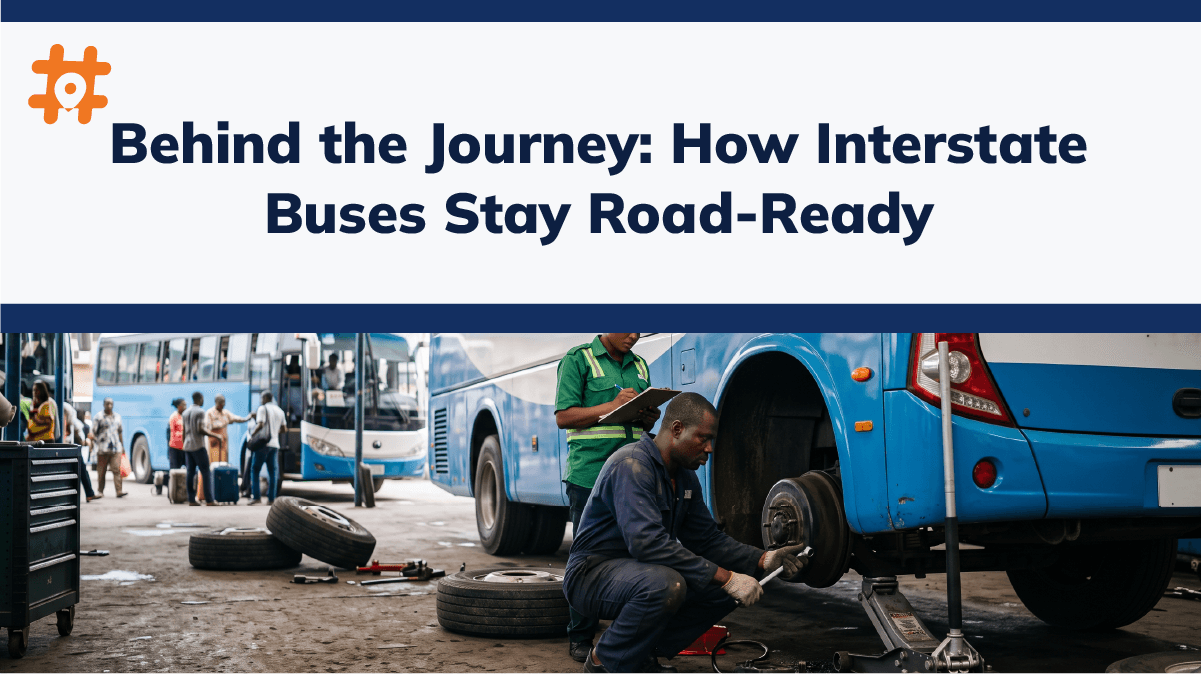
Behind the Journey: What It Takes to Keep an Interstate Bus Road-Ready
When a passenger boards an interstate bus, the journey often appears straightforward: arrive at the terminal, board the vehicle and travel to your destination.
But before that bus leaves the terminal, there is another part of the journey most passengers rarely see.
The vehicle has to be checked. Mechanical issues need to be identified. Worn components may need to be replaced. Drivers have to report problems they notice, while mechanics and operators have to determine whether a vehicle is ready for another trip.
And the process does not necessarily look the same across every transport company.
To better understand what happens behind the scenes, Intercity’s operations team spoke directly with transport managers and representatives at terminals about how they maintain their vehicles, the parts that require frequent attention and how vehicle ownership affects maintenance responsibility.
The conversations included Mr. Osinachi, manager of Riversjoy Travels; Madam Chika, manager of Ibom Express; Mr. Hammed, manager of Prince Line Transport; Miss Zainab, secretary for E-Express Motors; Mr. Peter, manager of Divine Choice Motors; Mr. Philip, secretary for CDO Motors; Mr. Fidelix, manager of Young Shall Grow at Jibowu Park; Mrs. Ogeh of His Grace Transport at Berger Park; and Mr. Otumba, manager of Grace Flow at Ikorodu Park.
Their experiences reveal that there is no single maintenance system used by every operator.
The approach can depend on the size of the operator, who owns the vehicle, how frequently the bus travels and the distance it covers.
Here is what happens behind the journey.
Vehicle Maintenance Starts With Who Owns the Bus
One of the most important insights from Intercity’s terminal conversations was that the person or company operating a bus does not always own the vehicle.
The operators interviewed broadly described three different operating models.
1. Larger operators with dedicated maintenance systems
Some larger transport operators have their own maintenance departments and mechanics responsible for inspecting and repairing their buses.
Mr. Fidelix, manager of Young Shall Grow at Jibowu Park, explained that larger operators may have mechanics who inspect their buses after a certain number of trips. According to him, some operators carry out checks after about five to seven trips to and fro, while others may use seven to ten trips, depending on the operator.
The number of trips can be linked to the distance each vehicle has covered, meaning maintenance decisions are not necessarily based only on a calendar.
Mr. Fidelix also noted that when drivers report problems with a vehicle, the operator’s maintenance team takes the complaint into consideration and works to address the issue.
For operators with their own maintenance teams, this provides greater control over the condition of vehicles within their fleet.
2. Operators with a mixture of company-owned and driver-owned vehicles
A second group consists of operators that own some of their vehicles while also working with drivers who own other buses.
Mrs. Ogeh of His Grace Transport at Berger Park described this category as smaller operators that may own roughly 20% to 50% of the vehicles they operate.
In this model, the operator can have direct responsibility for the vehicles it owns, while maintenance responsibility for other vehicles can fall more heavily on the individual driver or vehicle owner.
According to Mrs. Ogeh, this can result in different maintenance practices between company-owned and driver-owned vehicles.
The operator may maintain its own buses regularly while vehicles that are not company-owned are left to their respective owners or drivers to maintain.
3. Operators working primarily with driver-owned vehicles
The third model is where the operator does not own the vehicles being used for passenger transportation.
Instead, the operator works with individual drivers who provide the vehicles, while the operator provides access to a terminal and passenger-loading arrangement.
Mr. Peter, manager of Divine Choice Motors, said he does not have vehicle-maintenance concerns for the vehicles in his loading area because the vehicles are not owned by the operator and the drivers take care of their own maintenance.
A similar observation came from Mr. Otumba, manager of Grace Flow at Ikorodu Park, who explained that some operators have no vehicles of their own and rely on arrangements with drivers who own the buses.
In such arrangements, according to Mr. Otumba, the operator may have limited control over the maintenance of the vehicle because responsibility remains with the driver or vehicle owner.
He also observed that some vehicle owners maintain their buses regularly, while maintenance may be delayed in other cases until a vehicle develops a fault.
This difference in ownership is important because it shows why there is no single maintenance schedule that applies to every interstate bus in Nigeria.
How Often Are Interstate Buses Serviced?
One of the questions Intercity’s operations team asked was how frequently vehicles receive general servicing.
The operators interviewed gave different answers.
Mr. Osinachi, manager of Riversjoy Travels, said their vehicles are serviced weekly.
For Madam Chika, manager of Ibom Express, the maintenance cycle is even more closely connected to usage. She said their vehicles are serviced after every return trip because of the distance they cover.
These examples demonstrate why it would be misleading to assign one universal servicing schedule to all interstate buses.
For some operators, servicing may happen approximately twice a month. For others, heavy usage and long-distance routes can result in more frequent maintenance.
For some larger operators, maintenance may also be connected to the number of trips or kilometres a vehicle has covered rather than simply following a fixed calendar schedule.
That distinction matters.
A bus travelling long distances regularly can accumulate significantly more mileage than a vehicle making shorter or less frequent journeys.
As a result, maintenance decisions can depend on usage, distance, vehicle condition and the operator’s maintenance system.
So rather than asking only, “How often is a bus serviced?”, a better question is:
How much work has the vehicle done, and what condition is it in?
What Happens to a Bus After It Returns From a Trip?
Maintenance is not necessarily something that happens only when a vehicle develops a fault.
Operators interviewed by Intercity described routine checks carried out after vehicles return from trips.
Mr. Hammed, manager of Prince Line Transport, said that after a return trip they check components including the brake pads and tyres and change the oil if necessary to make sure the vehicle is ready for the next trip.
These checks may include areas such as:
- Brake pads
- Tyres
- Engine oil
- Oil filters
- Other visible or reported mechanical issues
The purpose is straightforward: identify problems before the vehicle is sent out again.
A driver returning from a journey may also report an unusual sound or another problem noticed during the trip.
If the issue requires urgent attention, the vehicle can be referred for inspection or repair rather than simply continuing with normal operations.
This creates an important maintenance cycle:
Journey → Driver feedback → Vehicle inspection → Servicing or repair → Vehicle returns to operation
In other words, the journey itself provides information that can influence what happens to the bus next.
Drivers Are an Important Part of Vehicle Maintenance
Mechanics may carry out the technical work, but drivers are often among the first people to notice when something about a vehicle feels different.
A driver spends hours operating the bus and can notice changes such as an unusual sound or behaviour that may not be obvious when the vehicle is stationary at the terminal.
The terminal feedback gathered by Intercity showed that drivers report these issues to managers or operators, particularly when the problem appears serious or requires immediate attention.
The manager of Riversjoy Travels told Intercity that drivers report when they hear unusual sounds from a vehicle when they return to the park, or notify the manager when an issue requires urgent attention.
That makes communication between the driver, operator and maintenance team an important part of keeping a vehicle road-ready.
A small issue identified early may be easier to address than a problem that is allowed to develop into a major mechanical failure.
Which Bus Parts Require Frequent Replacement?
Not every component of a bus wears out at the same rate.
From the operators interviewed, some of the parts mentioned as being replaced more frequently include:
Brake pads
Brake pads were identified as one of the components that require regular attention.
Mr. Philip, secretary for CDO Motors, identified brake pads among the vehicle parts that are most frequently replaced by operators. He noted that depending on the distance covered, brake pads can sometimes be changed multiple times within a month.
How quickly they need replacing can depend on factors such as distance travelled and vehicle usage.
This should not be interpreted as a universal replacement schedule for all buses. It reflects what an operator interviewed by Intercity reported about his operating experience.
Oil filters
Oil filters were also identified among the parts that may require regular replacement during servicing.
Fuel pumps
Fuel pumps were another component mentioned by Mr. Philip among the parts that operators may need to replace.
Tyres
Tyres naturally receive attention because they are directly exposed to road conditions and continuous use.
Their condition can change depending on mileage, road conditions, wear and other factors.
The larger point is that vehicle maintenance is not simply about fixing a bus when it stops working.
A significant part of the process involves monitoring components that experience regular wear and replacing them when necessary.
Not Every Repair Is a Routine Repair
While components such as brake pads, filters and tyres can form part of recurring maintenance costs, some mechanical problems are considerably more serious.
The manager of Riversjoy Travels identified the engine, brain box and gearbox as some of the most expensive vehicle components to replace when they develop faults.
The financial impact can be significant.
A major component failure can mean more than the cost of a replacement part.
The vehicle may be unavailable for operation while repairs are being carried out, potentially affecting the operator’s business and scheduled journeys.
The Riversjoy Travels manager also noted that the financial burden can become particularly challenging when an operator does not immediately have the funds required for a major repair.
For an operator managing multiple vehicles, these types of repairs can therefore become both a maintenance challenge and a business challenge.
Why Vehicle Ownership Matters More Than Passengers May Realise
From the passenger’s perspective, the name of the transport company may be the most visible part of a journey.
Behind that brand, however, the vehicle could be company-owned, jointly operated or owned by an individual driver.
That distinction can influence:
- Who is responsible for servicing the vehicle
- Who pays for repairs
- How frequently the vehicle is inspected
- Who makes the decision to remove a vehicle from operation
- How quickly a reported fault is addressed
This is one of the most interesting findings from Intercity’s terminal-level conversations.
The maintenance system behind an interstate journey can be influenced by the structure of the business operating the vehicle.
Regular Maintenance Does Not Mean Breakdowns Cannot Happen
There is an important reality that passengers should understand.
Preventive maintenance can help identify and address vehicle problems, but it cannot guarantee that a vehicle will never develop a fault.
Mechanical failures can happen unexpectedly, even when operators have maintenance processes in place.
Miss Zainab, secretary for E-Express Motors, made this point when she explained that vehicle breakdowns can happen at any time, even when operators have taken precautions.
That is why vehicle maintenance is only one part of the system that keeps interstate transportation moving.
There also has to be a plan for what happens when something goes wrong during the journey.
And that takes us to the second part of this series.
What Happens When an Interstate Bus Breaks Down?
A breakdown during an interstate journey creates a completely different operational challenge.
The priority moves from maintaining the vehicle to finding a way to get passengers safely moving again.
According to Miss Zainab of E-Express Motors, operators may respond differently depending on where the breakdown occurs.
If the affected vehicle is relatively close to Lagos or its destination, another vehicle may be sent from the park to transfer the passengers.
If the breakdown occurs farther away, the operator may look for a nearby transport park and arrange another vehicle to take care of the situation.
This process can involve moving passengers from the affected vehicle into another bus so that the journey can continue.
But what determines the response? How do operators coordinate another vehicle? What happens to passengers waiting on the roadside? And how does the situation differ when the breakdown occurs far from the operator’s home terminal?
We explore those questions in Part 2 of this series.
What Intercity Learned From Speaking With Operators
The biggest lesson from our conversations at the terminals is that vehicle maintenance is not one simple activity.
It is a combination of:
Vehicle ownership + servicing + inspections + driver feedback + component replacement + mechanical expertise + operational planning.
Different operators may approach these responsibilities differently, but the objective remains the same: keep vehicles in suitable condition for passenger journeys and respond when problems arise.
These findings are based on direct conversations conducted by Intercity’s operations team with transport managers and representatives at different terminals, rather than assumptions about how every operator in Nigeria operates.
The conversations also revealed something passengers may not always consider: the vehicle carrying them may belong to the transport operator, an individual driver or another ownership arrangement altogether.
That structure can influence how maintenance is organised and who is ultimately responsible for keeping the vehicle road-ready.
The next time you board an interstate bus, remember that the journey you see as a passenger is only one part of a much larger operation.
Before the bus reaches the terminal, maintenance decisions have already been made. After it returns, more checks may follow. And when something unexpected happens on the road, operators need another layer of contingency planning to keep passengers moving.
That is the part of interstate transportation passengers rarely get to see.
Frequently Asked Questions About How Interstate Bus Operators Maintain Their Buses
There is no single maintenance frequency that applies to every interstate bus. Operators interviewed by Intercity reported different approaches. Mr. Osinachi of Riversjoy Travels said their vehicles are serviced weekly, while Madam Chika of Ibom Express said their vehicles are serviced after every return trip because of the distances they cover. Other operators may use trip counts, mileage, vehicle condition or other maintenance schedules.
Operators interviewed by Intercity identified brake pads, oil filters, fuel pumps and tyres among the components that commonly require replacement or attention. Replacement frequency varies according to vehicle usage, mileage, condition and other operating factors.
It depends on the vehicle ownership structure. Some larger operators have dedicated maintenance departments, while smaller or mixed operators may maintain company-owned vehicles while working with driver-owned buses. Where the vehicle is owned by an individual driver, maintenance responsibility can fall largely on the driver or vehicle owner.
It depends on the vehicle ownership structure. Some larger operators have dedicated maintenance departments, while smaller or mixed operators may maintain company-owned vehicles while working with driver-owned buses. Where the vehicle is owned by an individual driver, maintenance responsibility can fall largely on the driver or vehicle owner.
According to the terminal feedback gathered by Intercity, some operators carry out checks after vehicles return from trips. Mr. Hammed of Prince Line Transport, for example, said their checks include the brake pads and tyres, with oil changed when necessary before the vehicle is prepared for another trip.
Yes. Regular maintenance can help identify and address problems, but it cannot eliminate the possibility of unexpected mechanical failure. Miss Zainab of E-Express Motors noted that breakdowns can happen even when precautions have been taken. This is why operators also need contingency plans for handling breakdowns during journeys.
Final Takeaway
Keeping an interstate bus road-ready involves much more than taking it to a mechanic when something goes wrong.
It can involve scheduled servicing, trip-based inspections, post-journey checks, driver reports, replacement of worn components and decisions about whether a vehicle is ready to return to the road.
And because not every operator owns every vehicle they operate, the maintenance process can vary significantly across the interstate transport industry.
These insights come from Intercity’s direct conversations with transport managers and representatives at terminals, including representatives from Riversjoy Travels, Ibom Express, Prince Line Transport, E-Express Motors, Divine Choice Motors, CDO Motors, Young Shall Grow, His Grace Transport and Grace Flow.
The conversations offer a look into an aspect of Nigerian interstate transportation that passengers rarely see.
Related Articles
Nigeria Interstate Travel Market: Safety, Fares & Demand Trends